

Precautions Male Teachers Need to Take in the Teaching Profession
Concerned about what precautions you should take to protect your professional image? Then read this blog to find out how.
Throughout my 18 years as a teacher, I have had many conversations with my fellow male teachers about what measures we need to take in order to protect ourselves professionally. This might come as a surprise to some, but male teachers need to be very careful with how they interact with their students.
Some of you will be crying sexism and think that it’s unfair, but this is how things are and it’s how they will remain for the foreseeable future. I guarantee you that any aspiring male teacher studying education at university will have been made well aware of this topic. A lot of this advice could also apply to women within the profession but for the sake of simplicity I will be referring to male teachers.
So why do male teachers need to be especially careful with their professional image and how they interact with students?
Well, essentially it comes down to the behaviour of other men. Men make up the majority of: murderers, rapists, psychopaths and paedophiles. If a person off the street was asked to describe a stereotypical criminal they would almost certainly be male. While I don’t have the official numbers on me, I would say men will make up most of the dismissals for: child abuse material, sexual misconduct and sexual misconduct with a student in NSW each year. The same goes for Queensland.
These statistics are the reason why teaching is one of the most heavily scrutinised professions. Since the introduction of the Working with Children Check (WWCC) and the TRBWA (Teaching Registration Board of Western Australia), I have been required to complete a police clearance every time my WWCC expires and every time I am up for re-registration. This works out to be every 2-3 years over 18 years.
The other reason is that an allegation of a sexual offence would instantly destroy your career, even if you were exonerated.
Would parents still trust you?
Would you still get work as a tutor?
Would you be rehired as a teacher?
Would you want to spend thousands of dollars clearing your name?
As the saying goes ‘mud sticks’. Just ask former Daramalan College teacher, Peter Cuzner, who was cleared of two child sexual assault allegations that came about as a result of the Royal Commission into child sex abuse. If there ever was a reason to join your teachers’ union, then this is it. When looking into the case against Mr Cuzner, all of this drama could have been avoided by following certain procedures and protocols. The first allegation occured when he drove a student from school to the Old Canberry Fair site. The second allegegation occured when a student had helped him with some gardening at Mr Cuzner’s home. Two things instantly popped into my mind when re-reading this story. Firstly, never drive a student anywhere without another staff member present. Secondly, unless your children are actually friends with the students at your school, never invite any students over to your home.
Now before you start chanting #notallmen and permanently shut yourself off from any form of physical contact with students just remember to apply some common sense to your dealings with students. So, let’s get into what precautions male teachers need to take.
Physical contact - hugs
Younger students are more likely to come up and spontaneously hug you.
If this happens, allow the student to hug you and then break off contact with the child and offer a small verbal compliment like ‘thankyou’ or ‘that was very kind of you’.
If a child continually hugs you, then you need to have a conversation with their parents about respecting your personal boundaries.
In situations where a younger child is visibly upset or hurt, then physical contact to reassure the child would not be seen as suspicious.
It is inappropriate to initiate a hug with a student in the majority of cases especially with older children.
PHYSICAL CONTACT - PHYSICAL EDUCATION
If you are running a physical education class which requires you to correct a student with their physical technique just make sure you tell a student beforehand. If they object, don’t force the issue. It’s not a battle worth having.
The same goes for situations where you will make physical contact within the context of the game.
Physical contact – within the classroom
Make sure you announce what you are going to do before you do it. This helps with your students who might be the anxious type.
Some students have seen domestic violence and may have experienced significant trauma, physical conduct could cause a situation where a student will react in an unpredictable manner and violent manner.
This can include: correcting a students handwriting grip, typing style etc.
This can also include: a guiding hand to help a student with where they need to go if they are distracted or to remove them from a potentially harmful situation.
Physical contact – behaviour management
I could write an entire blog post about this topic
Always use the holds and restraints that your employer recommends e.g. TeamTeach
Always get help from admin if you need to initiate a restraint or have commenced a restraint. Ideally, only admin should be restraining students as a last resort. The majority of escalations can be prevented through trauma informed teaching practices and by taking preventative steps.
If you are not in the position to physically help, then make sure you are doing something to help the situation. In this instance I am referring to two six foot five high school students fighting and the closest teacher just happens to be five foot five.
If a student has totally lost control over their behaviour, it is best to evacuate the classroom and keep everyone else safe. Windows and equipment can be replaced. We have lockdown procedures for a reason.
Situations where you are alone in the classroom with a student
If you are in a situation where you need to mind a student in your classroom by yourself make sure you keep the door open at all times.
Ring, send a text message or email admin that Joe Bloggs is in your classroom.
It’s a good idea to have a student at the back of the classroom or a considerable distance away from you if you are just minding them.
I have a large class panel as part of my classroom door. I do not keep any classroom print or annoucements on it so anyone can clearly see what is going on at all times.
Situations where you are driving students
Never drive a student in your car by yourself.
A group of students are a different matter but never with a single student.
Social media
Set your profile to the highest security setting possible.
Mention to the classroom that you never add any students to your account on social media and outline what steps you will take if they do.
Consider changing your name to something else, many teachers do this.
If a student contacts you, do not respond. Tell admin the next day and then send an email to the parents. Proof of a paper trail is much clearer than a phone call because the contents of a phone call can be disputed. Another alternative is a meeting with the parents with admin present.
For more information and if you are from WA, please read through the TRBWA’s Student-Teacher Professional Boundaries resource.
Swimming lessons
As a primary school teacher you will be in situations where you will need to supervise students changing after their swimming lessons.
Ideally you would want two male teachers in the change rooms at all times when supervising the boys.
There will be situations where you will need to help kids change. Obviously you wouldn’t refuse help to a pre-primary student who is struggling with changing. Make a note of who you helped and inform admin.
FINAL THOUGHTS
Remember that context is incredibly important when determining if physical contact with a student was justified or not. While this list is not exhaustive these precautions are an important part of maintaining your professionalism with students. These precautions will also help reduce the likelihood of you ever being accused of misconduct by another person.
If you think this website is awesome then please ...
Bookmark this page.
Follow us on Teachers Pay Teachers
Follow us on Instagram | @griffin_edu
Like and follow us on Facebook | @griffineducationenterprises
Join our mailing list down below.
And most importantly, share this website with other educators!







Aboriginal Australian Words and their Etymology
For those teachers who are interested in taking this project further and applying it to their teaching context, here is the PowerPoint that my class and I created. It seems a shame to let this project sit ideal on a hard drive somewhere so I thought that I would put this on the internet.
Please contact me on social media if you have any question.
How I Redefined My Relationship with Alcohol
If you have ever been interested in reducing your alcohol consumption, then this is the blog for you.
On the 25th of July 2020 I reached a personal milestone of mine that I would have considered impossible to achieve five years ago. I managed go without alcohol for six months (183 days). When I thought about my alcohol consumption since I turned 18, I could not think of a time where I abstained from alcohol for longer than three months. I had read about celebrities who had drastically reduced their alcohol consumption, but I never considered that I could do the same thing, until now.
Before I get too far into this blog, I want to clarify my former level of alcohol consumption. Back when I used to drink, I was more of a social drinker and I did not typically drink during the weekdays. A big night for me would be about 6 drinks. I never had the constitution to drink large amounts of alcohol. Nights like these only occurred during University breaks and when I knew I could let my hair down.
The overindulgence of alcohol has not interfered with my studies, work or spilled over into other areas of my life. The only time I experienced hangovers were on days when I had no prior commitments. I have always had the power to stop drinking when I chose to, plus I did not really have the income to support a greater consumption of alcohol before I started working full time.
My addiction to alcohol is on the lower end of the spectrum of alcohol addiction. We all experience addiction of some sort, and to deny this fact is to place ourselves above human nature. My desire for change does not come from a place of crippling addiction, but rather, a desire to live my best possible life. I reached a point where I had to make a choice.
Should my money go towards a temporary state of mind that alcohol provides, or should it go towards new experiences with my family and lifestyle enhancing products?
With this clarification out of the way, let us go back to a question that you might be asking yourself. So how did I manage to achieve this personal goal of mine? Well I did not achieve it overnight. Just like a smoker trying to quit for the first time, I have failed in my attempts to go past three months without drinking. Going without something that gives you pleasure is hard, but with the right strategies, it is possible to do. All you need is the desire to start the process of reducing your alcohol consumption.
Finally I will add a little disclaimer of mine, if you are struggling with alcohol addiction and it has interfered with the different areas of your life, then please seek professional help as this advice is general in nature.
CHANGE YOUR ENVIRONMENT
One of the best ways to reduce your alcohol consumption is to actively change your environment.
So what do I mean by this?
My wife’s Oma, bless her soul, regularly gives Alexandra a bottle of Brown Brother’s Rose Moscato every time she visits; however, my wife and I have not had the heart to tell her that we are currently abstaining from alcohol.
To tell her otherwise would break her stern but loving German heart.
Previously we kept our alcohol in the fridge, but since we aren’t drinking, we have been putting all of our bottles downstairs in the garage. So far, we are up to 26 bottles of wine and 12 cans of beer. This action of ours is what James Clear, the author of Atomic Habits, refers to as environmental design. By adding friction, which is to make the behaviour of drinking difficult to engage in, we are giving ourselves, our future selves who might want to drink after work, the best possible chance of success.

If you want to break a bad habit or behaviour, then you need to make it exceedingly difficult or down right impossible to engage in said behaviour.
If my wife and I felt like a drink, then we would have to:
Go downstairs to the garage
Bring the bottle back up the stairs
Put the bottle in the fridge
Wait for the bottle to chill
Sounds like a lot of work doesn’t it? We could go even further and give away the alcohol; however, we like the idea of using Oma’s bottles of wine as a metric of our non drinking behaviour.
As the saying goes. Out of sight, out of mind.
SET BOUNDARIES WITH ALCOHOL
If you still want to drink alcohol but you’d like to drink less, then setting firm boundaries about when you drink, where you drink and how much you drink will go a long way towards reducing your alcohol consumption.
I first began to set boundaries for my alcohol consumption when I turned 19. While out with friends, I established the habit of having a small glass of water between drinks. I did cop some flak from my mates with this new habit, however, I wasn't the one waking up with a crippling hangover (at least some of the time).
Some other boundaries you might want to set could include:
Only drink on weekends
Limit yourself to 1-2 drinks
Only drink socially, never alone
Once you have decided on your boundaries, and you're serious about committing to them, then one of the best things that you can do to support yourself is to write them down and place these boundaries in a location where you will see them every day. By doing something as simple as writing things down and looking at them every day, you are actively reinforcing a desired behaviour that you want to establish.
Starting small with goals like these can give you the confidence boost that you need if you were to consider abstaining from alcohol for a longer period of time.
TRY ABSTAINING FROM ALCOHOL FOR A LONGER PERIOD OF TIME
I distinctly remember my last period of abstinence from drinking and how I broke the streak. It was down South at Margaret River. All of my family had made the trip down to my parents’ holiday home during the Easter Holidays of 2016. My family and I spent about a week down there and everyone had been drinking each night for the past four days. On the 5th day I ended up breaking my three-month streak and accepting a glass of champagne.
I'd never felt cravings like that before and such an experience worried me. This event got me thinking about the following question for the first time. “Was I in control of the alcohol or was the alcohol in control of me?” Unfortunately, in this situation it felt like the latter. Such an experience felt deeply unsettling to me. How could my cravings for alcohol influence my behaviour? Prior to reaching six months without alcohol, I usually participated in dry July and I would occasionally have a sober term. While I was able to channel enough will power to give up alcohol for a month or a term, I still found myself craving a drink at the end of these dry spells.
While I did fail the drinking test when I was with my family during the Easter Holidays, this experience opened my eyes to how I craved alcohol. This also brings me to another point, without going through this experience and attempting to give up alcohol for a longer period of time, I might not have been in the situation where I was able to give up alcohol for six months. I consider these smaller stints of abstinence to be the building blocks towards my current level of success.
SERIOUSLY THINK ABOUT YOUR ALCOHOL CONSUMPTION
If you are thinking of reducing your alcohol consumption, then you need to take stock of how much money you are spending on the habit. In 2018 I calculated the amount of money that I had spent on alcohol and lottery tickets for the entire year. I had gotten into the habit of purchasing: a weekly ticket, a carton of beer once I had run out and a bottle of wine for my wife.

After I had looked through my bank statements for the year, I spent about $2000 on alcohol and $1000 on lottery tickets. The occasional carton of beer and lottery ticket didn't seem like much, but when this weekly habit was compounded over a year, I was shocked at just how much I had spent.
This revelation got me thinking about what else I could spend my money on.
I had been thinking about purchasing a bike for quite some time and my children we're getting to the age where they needed a proper bike of their own, not the cheap ones from Big W but ones with gears and suspension. Armed with this new information, I could not in all good conscience continue to spend money like this while foregoing important lifestyle enhancing purchases.
Another question that I asked myself was this. Why should I spend money on a temporary state of mind when I could permanently have a new device or gadget that will bring me joy? I still look back on spending that $3000 with regret because I could have redirected that money towards a holiday or a family experience.
This year, my wife and I have redirected this money towards lifestyle enhancing purchases that help us get closer towards our dreams and goals.
Now I/we own:
Every family member has a new bike
A shotgun seat for my bike
A bike rack for the car
A body weight station
A soda stream to help substitute alcohol
My own pair of AirPods
A Rode NT USB microphone for my YouTube videos

IDENTITY BASED HABITS
An important thing to consider when trying to reduce your alcohol consumption is to think of your ideal self:
What would your ideal self-look like?
Where would they be?
What have they managed achieved?
If your ideal self were to walk in the room right now, let us say 5-10 years down the track, what would they say? This is a strategy that I utilised to help gain control over my alcohol addiction. I read about this strategy in High Performance Habits by Brendon Burchard and it is also mentioned in Think and Grow Rich by Napoleon Hill. In my letter to my future self, I wrote down things that referenced my ideal weight, what I had spent my money on, and how giving up alcohol had allowed me to be more productive.
My letter to my future self also talked about how my children would never see me hungover or vomiting from a night of heavy drinking. When I got my pride involved and how I wanted my children to view their father, it provided me with a powerful reason to make sure that I stuck to what I said and that I had followed through with my intentions. I wanted my children to look at their father with pride and say something like, I remember when dad was able to give up alcohol for a year because he chose to do so. Wow, that thing was hard, but my dad managed to do that, and if my dad can do something like this, then I know that I could do something like that as well.
When I involved my perception of how I view myself as a good parent, I noticed something different with my cravings. The cravings for alcohol began to wane, almost to the point where they have disappeared.
Additionally, I began to see myself as not someone who is trying to give up alcohol BUT as someone who does not drink. For example, when I would decline a drink, instead of saying ‘No thanks I'm trying to give up alcohol.’ I would say ‘Sorry I don't drink alcohol’. A subtle change in how you say something can have a profound effect. The difference between these two sentences is in the semantics, one response is solely relying on motivation and will power alone, and the other is wrapped up in one’s identity with how they see themselves.
Will-power can fail you when you need it the most, but you are less likely to fail if a behaviour is a core part of your identity.
FINAL THOUGHTS
The most important point that I want to impress upon you is this. Do not fall into the trap of thinking “If I cannot do it perfectly, then it’s not worth doing it all.” You are unlikely to change your drinking habit overnight. If you have been wanting to reduce your alcohol consumption, but six months seems too hard to do, then set your sights on a smaller goal that is achievable. It is extremely difficult to give up something so enjoyable, not unless the stakes are incredibly high, like an alcoholic who has developed early signs of cirrhosis of the liver.

Here is a rehash of all the things you can do:
Write down some boundaries that limit your alcohol consumption and then place these boundaries in a visible location.
Do an audit of how much money you spend on alcohol in a year and seriously think about where else that money could go.
Write down a list of lifestyle enhancing purchases that you would like to redirect your money towards instead.
Write a letter to your ideal future self. When writing this letter, make sure you get your pride involved, especially if you have children as that can be a powerful source of motivation
If you have major concerns about your alcohol consumption, then make sure you seek professional help as this blog is only providing advice that is general in nature.
Finally, if you would like to learn more about the books that I have referenced, I have included an Amazon Associates link to them. If you choose to make a purchase, then I earn a small commission that is not included on top of the final price of your purchase.
OTHER BOOKS THAT HELPED ME TO REDUCE MY ALCOHOL CONSUMPTION INCLUDE
Maximum Willpower by Kelly McGonical
The Power of Habit by Charles Duhigg
3 Personal Development Books that Represent Incredible Value
All of these incredible personal development books come to less than $7!
Maybe it’s me, but one of the things that holds me back from purchasing a new book is often its price. Some books cost an arm and a leg, and there is nothing worse than the feeling of buyer’s remorse when reading a book that does not meet your expectations.
But I guarantee that this won’t be the case with the following three books.
The two great things about these books is that they are packed full of useful information such as productivity and conflict resolution strategies, AND their price is ridiculously low. The Kindle versions of these books come to less than $7. With so much value, even Ebenezer Scrooge will feel like paying more.
So here are ‘3 Personal Development Books that Represent Incredible Value’.

10 STEPS TO EARNING AWESOME GRADES
If there ever was a book that I wish I had read earlier in my life, especially when I was studying at university, then 10 Steps to Earning Awesome Grades by Thomas Frank would be it. If I was the parent of a child who is currently in year 11 or 12, then I would immediately buy them this book.
For those of you who don’t know, Thomas Frank is a world famous productivity expert, YouTuber and founder of CollegeInfoGeek.com. 10 Steps to Earning Awesome Grades is packed full of productivity tips and strategies that you can implement straight away. From the moment you open his book, it becomes apparent that Thomas REALLY knows his stuff. In 10 Steps to Earning Awesome Grades, Thomas talks about:
How to plan like a general and stay organised
How to study effectively and the optimal conditions for studying
How to write better and how to get through the dreaded group project
The best tip that Thomas writes about would have to be the project management app called Trello. Trello uses the Kanban system of cards and categories which was developed by Toyota to help oversee their manufacturing process of automobile parts. It runs very similar to a to-do-list but it’s far more visual, and, at a moments notice, you can instantly see where you are in your workflow process. Currently I have made Kanban boards in Trello for the following workflow processes:
Keeping track of the numeracy committee than I run at my school
Creating YouTube videos and everything that goes along with this process
Monitoring all my writing tasks like scripts, book reviews and blogs
Tracking my ideas and where I am at with creating TPT products
I have embedded a video about Trello down below for those of you who are interested in learning more.
Thomas has deliberately kept the price of 10 Steps to Earning Awesome Grades incredibly low, so it’s ridiculously affordable for university/college students, but having read this book, there is nothing stopping a high school student from picking it up and getting something from it as well.
You can purchase the Kindle version of 10 Steps to Earning Awesome Grades for $1.36 at Amazon.
HOW TO WIN FRIENDS AND INFLUENCE PEOPLE
If there ever was a book that provides a master class in diplomacy, then How to Win Friends and Influence People would be it. Written by public speaking coach Dale Carnegie back in 1936, How to Win Friends and Influence People details an incredible range of strategies for resolving conflict, and how you can look at life’s many problems with a different point of view.
Being a teacher myself, a lot of the strategies that he talks about are directly applicable to the sources of conflict that teachers will encounter. I know because I have used them myself, I’ll detail more about these strategies in a future book review for How to Win Friends and Influence People. But first, let me share with you my favourite quote from How to Win Friends and Influence People

The moment I read this quote, I realised that I could have shown more warmth towards my children with respect to how I speak to them when they make mistakes. As parents, we want the best for our children; however, this desire can sometimes lead us to over-criticising them. I previously had a tendency to criticise my eldest daughter for all of the things that she wasn’t doing at home.
Why hasn’t she cleaned her room, why hasn’t she put away the dishes and why hasn’t she put her bag back in the bag rack. The harsh wind of criticism coming from me could be quite strong sometimes and in these moments my daughter’s eyes would glaze over.
How dare a child behave like a child! 🤷♂️
About six months ago I made the switch to a warmer approach, such as praising her more often for the progress that she has been making with keeping her room tidy and when she completed her flute practice without prompting. If she made something 1% better, than I praised her for it. Having made this change to how I parent, I’ve noticed a positive change within my daughter. Her overall levels of happiness have been higher, she’s getting more enjoyment from school and she’s been managing her chores better than before. Mind you she still forgets the odd chore, but the change within her has been noticeable.
Some people are willing to pay thousands of dollars to have better relationships with their family members, and I’ve managed to achieve this by simply reading a book.
Perhaps this is something that you could do as well? 🤔💭
You can purchase How to Win Friends and Influence People on Amazon for $0.79!
THE MOTIVATION HACKER
The Motivation Hacker by Nick Winter, which is part self development book and part auto-biography, details Nick’s 3 month journey towards achieving 18 Goals of his in record breaking time. Some of his ridiculously ambitious goals include:
Running a half marathon
Creating a language/studying app call Skritter (it’s perfect for learning Japanese & Chinese)
Writing an incredible best man’s speech
Learning how to lucid dream
Developing a better relationship with his girl friend.
Nick resorted to some pretty extreme tactics to achieve his goals, tactics such as pledging $7,290 to a charity in the event that he didn’t fulfil his goal of writing this book! I admire Nick for the lengths that he took to achieve his goals and I also appreciated how openly he talked about his socially awkward former self.
The best strategy I learnt from The Motivation Hacker was the concept of input based goals. Instead of focusing on output, like creating a YouTube video once a week, I have been focusing on something that I know that I have full control over, which is the amount of time (my input) I spend creating YouTube videos. By changing my mindset in this area, my motivation to create YouTube videos has been stronger and I haven’t beaten myself up when I missed a deadline. I am still a beginner after all. I know that I showed up and learnt new skills, so to me, that’s what counts the most. The output will eventually come as I gain more experience, but for now I need to be patient.
A question to ask yourself would be this, in which areas of your life could you be more input focused instead of output focused? 🤔💭
Nick also talks about other motivation enhancing strategies, such as the concepts of success spirals and time coins; however, I wouldn’t want to spoil the book for you other than saying these strategies are useful to know and that they have influenced my thinking.
You can purchase the Kindle version of The Motivation Hacker for $3.99 on Amazon.
So there we have it, that was 3 Personal Development books that represent incredible value.
FYI, you don’t need to own a Kindle e-reader to download these books, you could purchase them from your phone or tablet on Amazon.com.au and then download them to your Kindle app. So there is no reason why they shouldn’t reside within your book collection.
IF YOU THINK THIS WEBSITE IS AWESOME THEN PLEASE ...
Bookmark this page.
Follow us on Instagram | @griffin_edu
Like and follow us on Facebook | @griffineducationenterprises
Follow us on Twitter | @Griffin_Edu
Follow us on Pinterest | Griffin Education Enterprises
Join our mailing list.
And most importantly, share this website with other educators!
How I Redefined My Relationship With My Phone
Want to change how you use your phone?
Then make sure you read our latest blog.
Throughout 2019, I felt uneasy about how much time I spent on my phone. While I certainly wasn’t a phone addict, I was concerned about how this device was affecting my productivity and the relationships I have with my family. Both my wife and I were guilty of being on our phones when we really should have been spending quality time with each other. How often have you found yourself in situations where you were ‘scrolling’ on your phone instead of enjoying the company of your family and friends?
I know that I have been guilty of this on several occasions.
This sort of interaction, or lack thereof, has become a hallmark of how we socialise with people. At the start of this year I set myself a goal to conquer this bad habit. I didn’t break this habit overnight, but I did achieve a greater level of mastery over my phone within 3-4 months. I found the following strategies useful so maybe they might help you as well.
Here are 4 ways I redefined my relationship with my phone.
Think about how you REALLY use your phone

I came across this quote, or words to this effect, when I was listening to one of my podcasts during my daily commute to work. This quote comes from Mel Robbins during an interview that she did with Tom Bilyeu from Impact Theory. I was struggling to summarise how I truly felt about my phone until I heard Mel’s quote. I had set myself some ambitious goals in 2020; however, I was choosing to invest my mental energy into the irrelevant opinion of some narcissistic attention-seeker by mindlessly scrolling on social media.
As I thought about this quote some more, I asked myself if I was really ‘moving the needle’ when it came to making progress with my goals and aspirations in life?
The answer was no. Well, not as much as I could if I kept on browsing social media.
To remind myself of this quote every day, I used a photo from a dream that I recently brought into reality. The memorable moment in question was the first bike ride I went on with my daughter. I took Mel’s words and put them as a text overlay on top of this treasured photo. I was able to do this in an app called Typorama for those of you who are wondering. I then set this newly created photo as my phone’s background.
Now when I open up my phone, I’m greeted with this powerful saying. This simple change has helped me to reconsider if I really need to use my device.
Limit what you use your device for
The great thing about smart phones is their versatility, but in some instances, this can be a major drawback. Before these life changing devices came along, electronic devices weren’t so flexible and we usually needed one device for one purpose.
Need to film something? Then use a hand-held video recorder.
Want to listen to some music? Then get out your iPod and head phones.
Waking up late? Then purchase an alarm.
You get the idea; however, if an iPhone can meet all of these needs (and many others), then we automatically increase our reliance on them. With each new task that a smart phone can fulfil we become beholden to them 1% more, but not unless we allow it.
Let me give you an example.
About three years ago I made the decision to purchase all of my e-books via the Kindle app. I wanted to move from reading on the iPad to reading on a Kindle, so in the event I finally purchased a Kindle, then all of my books would transfer over. In October 2019, I made the leap and purchased a Kindle Oasis and I tell you what, I haven’t looked back. In the future, I’d like to write an in-depth review about my Kindle Oasis but here is the short version.
Having a dedicated e-reader meant that I was no longer distracted by the convenience of having a quick look at social media. Sometimes a quick look stayed as a quick look but occasionally it turned into a complete waste of time. Yes, I turned off the notifications for all my social media accounts; however, I found that the temptation was still there. By having a device that is solely dedicated to reading meant that I was fully immersed in the reading experience for longer.
I would go as far to say that I now identify as a reader thanks to a device that is solely dedicated to reading.
Redesign Your Home Screen
An author who has helped me to redefine my relationship with my phone is James Clear. For those of you who don’t know who James is, he’s the author of ‘Atomic Habits’. I recently read Atomic Habits and I can confidently say that it is the best personal development book I’ve ever read. Without spoiling the book too much, one of the ways you can break a bad habit is to increase the level of friction associated with the habit. Basically you need to make it harder for you to perform the behaviour you want to change.
When I thought about the behaviour that underpinned how I accessed social media on my phone, the process was almost frictionless. Unlock the phone with my fingerprint, open the social media file on my home-screen and one touch later I’m mindlessly scrolling on Instagram or Facebook. Several hours could easily pass by and what did I achieve? Nothing!
To increase the friction associated with this behaviour, I decided to redesign my home screen. And when I say redesign, I mean completely redesign. I wanted my home-screen to represent the person who I want to be, not the person who I was.

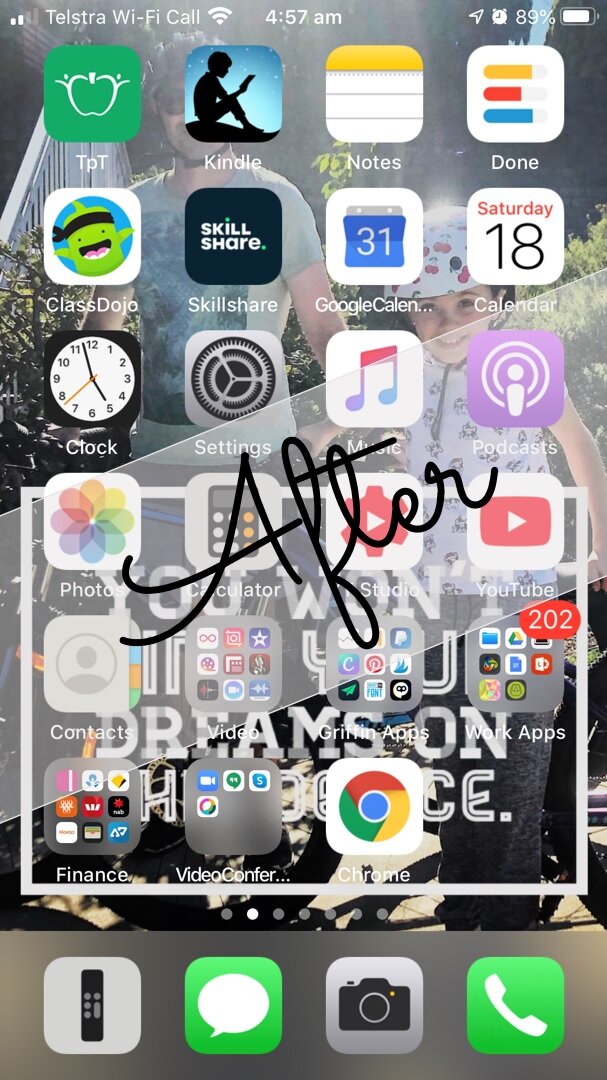
Here are the changes I implemented.
First, I took the social media folder off my home screen and put it on a screen that is further away. If I wanted to access Facebook, then I had to swipe over five more times or I had to search up Facebook. This simple action made it harder for me to access social media, but I wasn’t done there. I decided to rename my social media folder to ‘waste of time’ to remind me of my bad habit.
I also applied a similar idea to the news apps that were installed on my phone. If you’re like me, then you’re probably sick of the 24/7 news cycle related to the COVID-19 pandemic. I didn’t want to delete them from my phone, but I did want to significantly reduce the amount of time I spent on them. I took the news apps out of my news folder, placed them in separate folders and renamed them to something ‘different’. Here is the sentence that the folders spell out.
‘💩 that will rot your brain’.
Lastly, I only placed apps on my home screen that would help me achieve my goals. All of the apps that would take my attention away from these goals were banished to another screen. You can see a remarkable difference between the two home-screens in the video below. By redesigning my home screen and deciding what I CHOOSE to have on it, I made it easier to support the habits I wanted to build, and I made it harder to engage in the habits I wanted to break.
Put Your Phone in Phone Prison
Out of all the strategies that worked for me, the concept of ‘phone prison’ worked the best. Lately I’ve been writing down all of my routines with the goal of finding ways to improve them. It was here where I came across the idea of ‘phone prison’.
So phone prison works like this.
When you first wake up, you need to put your phone in prison. Phone prison is a predetermined location in your house where your phone stays for the entire day. Now just because your phone is in phone prison, it doesn’t mean you cannot come over for conjugal visits but beware, the warden of phone prison has set up some very strict rules for my visits.
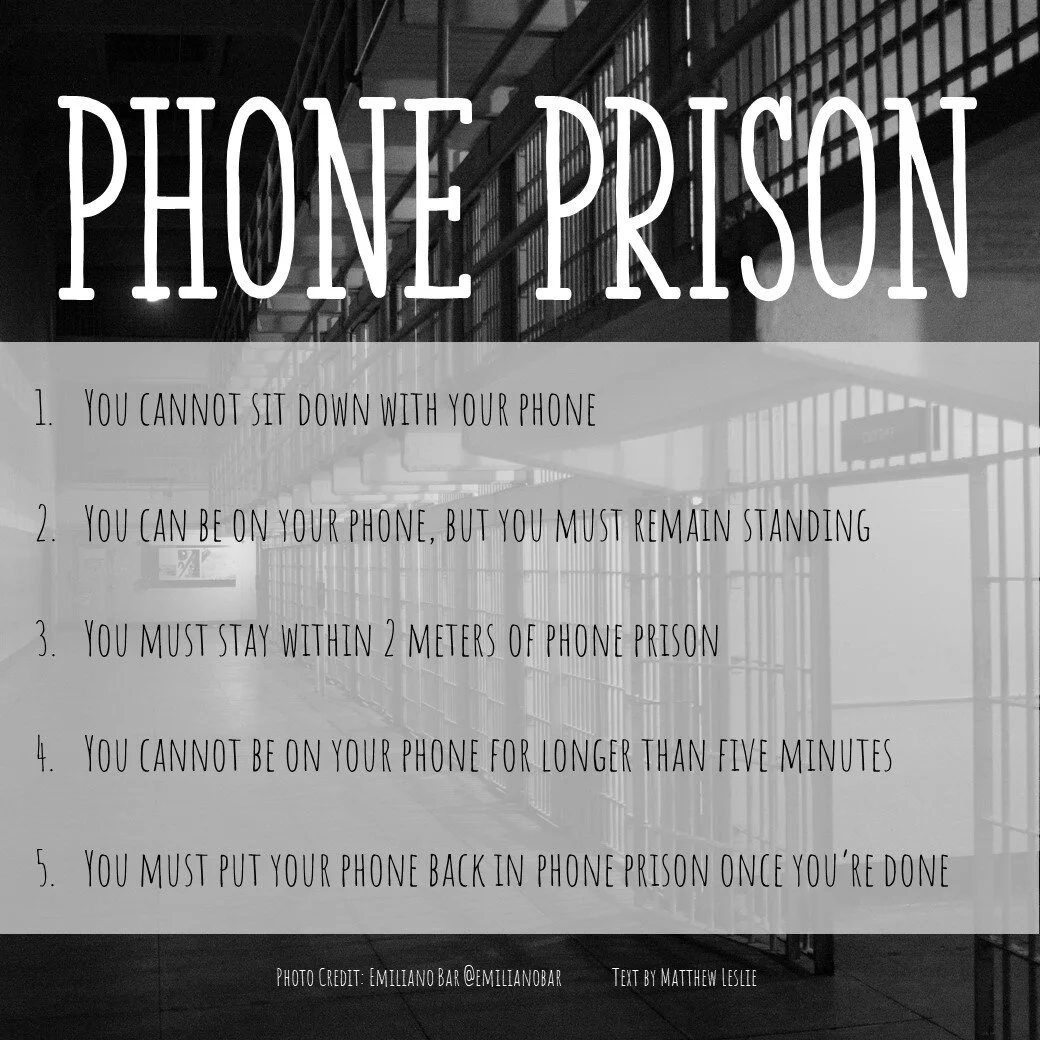
Like so many prison-based relationships, I found it pretty hard to deal with the loss of my beloved phone; however, just like many prison-based relationships, I found myself on the rebound quite quickly with more productive endeavours, like watching Skill Share or writing this blog.
I’m sorry social media, it’s not me, it’s you. You were great and all, but it’s not working out.
Final thoughts
If this blog has sparked your interest, then I encourage you to critically look at how and why you use your phone. Are you looking at your phone because you’re bored or are you procrastinating on starting that project of yours? I don’t want people to get rid of their phones because they are incredibly useful, but it’s worth thinking about how you really use it.
Remember, your phone is a tool that is meant to serve you, not the other way around.
IF YOU THINK THIS WEBSITE IS AWESOME THEN PLEASE ...
Bookmark this page.
Follow us on Instagram | @griffin_edu
Like and follow us on Facebook | @griffineducationenterprises
Follow us on Twitter | @Griffin_Edu
Follow us on Pinterest | Griffin Education Enterprises
Join our mailing list.
And most importantly, share this website with other educators!
How to Successfully Teach Pixel Art in Your Classroom
Looking for a guide on How to Teach Pixel Art in Your Classroom?
Then you’ve come to right blog!
During semester one of this year I came across a new style of art called Pixel Art. I was sitting in one of the classrooms of Bassendean Primary School listening to a presenter speak. As I looked around the room, I saw some Pixel Art self-portraits displayed on the walls. After having a good look at the amazing work the students created, I did some research into the Pixel Art niche.
Before I explain how I used Pixel Art in my classroom, I must offer up a word of warning.
Don’t let your students blindly search for Pixel Art on the internet by themselves. They might accidently come across *cough* some inappropriate content. Search up ‘Pixel Art’ in Google Images and you’ll know what I mean.
I strongly suggest that you upload appropriate pictures and website links to Connect or another platform that allows you to safely distribute digital content to your students. Set your rules about what they can and cannot look up and make sure they, and their parents, have all signed an ‘ICT Code of Conduct’ form.
Now don’t let these precautions put you off from running Pixel Art in your classroom. There is some amazing content out there that students will love to recreate and will help provide inspiration for their own original creations.
So let’s dive into ‘How to Successfully Teach Pixel Art in Your Classroom’.
WHAT IS PIXEL ART?
Pixel Art is a form of digital art that focuses on one thing, the humble square shaped pixel. Your computer monitor, smart phone and even the old Nokia 3310 has a liquid crystal display (LCD). LCD screens are made up of thousands of pixels. Pixels are the tiny squares that change colour in response to the image displayed on your screen. If you squint hard enough, you can probably see them on the device you are currently reading this blog on.
When video games became popular in the 1980’s, computer game developers only had a limited number of pixels and colours to work with. These technological limitations are why the 1st, 2nd and 3rd generation of video game characters looked ‘blocky’. But the children (and adults) who played video games back then didn’t care about the graphics and I’d make the argument that their original design forms a large part of why video games are still popular today.
I cannot imagine the original version of Mario, Sonic or Mega Man looking any different.



PIXEL ART PAPER
Firstly, you’re going to need some graph paper; however, the graph paper you order from Office Works might not be suitable. Your classroom’s needs will depend upon what sort of Pixel Art you want your students to create. The good news is that there are many websites on the internet that can meet this requirement. Here are a list of sites that can generate the necessary graph paper templates that you’ll be needing for Pixel Art:
To create the original blocky feeling from the Nintendo Entertainment System, Atari 2600 and even the latest generation of games with a retro feel, then you’re going to need graph paper with larger squares (1 - 0.75 cm).

As newer video game consoles were released (SNES & Mega Drive) the pixel count increased on the character sprites. In this instance, you might need graph paper with smaller squares (0.5 - 0.25 cm). This type of graph paper is also useful for students whose Pixel Art will contain a lot of detail, detail such as backgrounds, characters, trees etc.
See the guide down below for more information.





When creating your graph paper in Incompetech, I recommend setting the number of squares to 300 across by 300 down. I recommend using this setting for three reasons:
This will maximise the space that students can work with.
If students want to cut out their Pixel Art images, then any leftover paper can be saved for smaller pieces of Pixel Art.
This also prevents graph paper from being wasted.
PIXEL ART IDEAS
Now that we have the paper, it’s time to get started with the ideas!
My year 5/6 classroom loved creating Pixel Art sprites based around popular culture and video game characters. Examples include:
Star Wars
Pokemon
Adventure Time
Terraria
Minecraft
I conducted a survey of what things my students wanted to replicate on paper and then went about screen-shooting their Pixel Art requests. My students requested characters like Luigi, Pikachu, Steve from Minecraft, Charizard, Finn, Jake, Princess Bubblegum, Bowser, Ralph from Wreck It Ralph etc.



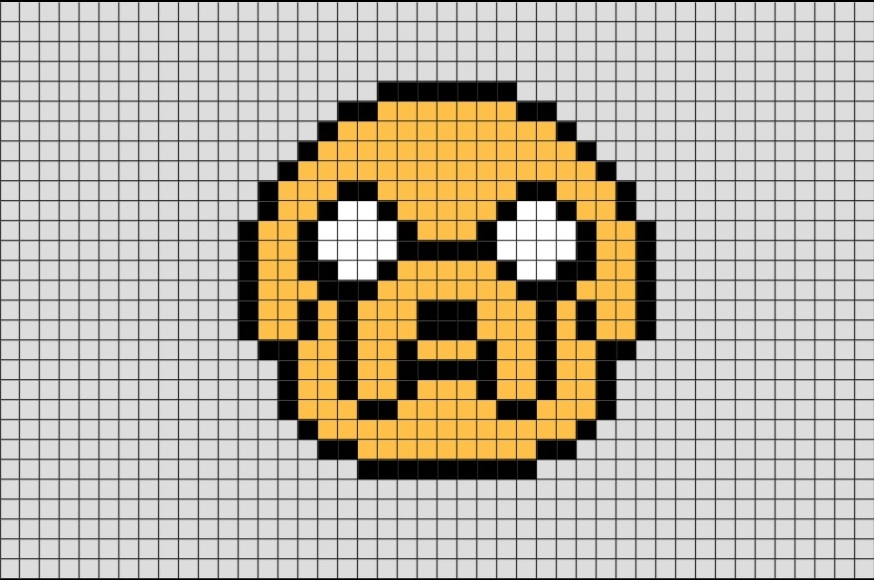

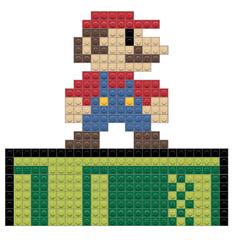

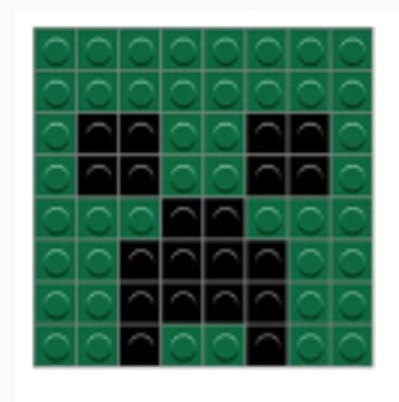
Once I had an impressive collection of Pixel Art images on my computer, I then uploaded these pictures onto Connect. I was pretty strict with making sure that my students only used Connect to access these ‘teacher approved’ pictures. On a side note, Google’s kid friendly search engine Kiddle blocked out all images of Pixel Art. So unfortunately this search engine, which is usually very useful, won’t be of any help.
Once my students had recreated a few pieces of their favourite Pixel Art images, I got them to brainstorm ideas for their own original creation. I kept this particular task open ended and I allowed my students to choose what they wanted to create (assuming it was appropriate of course). They needed to create a digital version of their Pixel Art image at PixelArt.com and they also needed to create their art form using graph paper.
Once the digital version of their Pixel Art images were finished, students emailed me copies of their Pixel Art. We established the assessor & assessee protocols and then went about evaluating the quality of each other’s work against a jointly created assessment rubric.
Here are some examples of what my students created.






PIXEL ART WEBSITES
1st Recommendation for Digital Designs - PixelArt.com
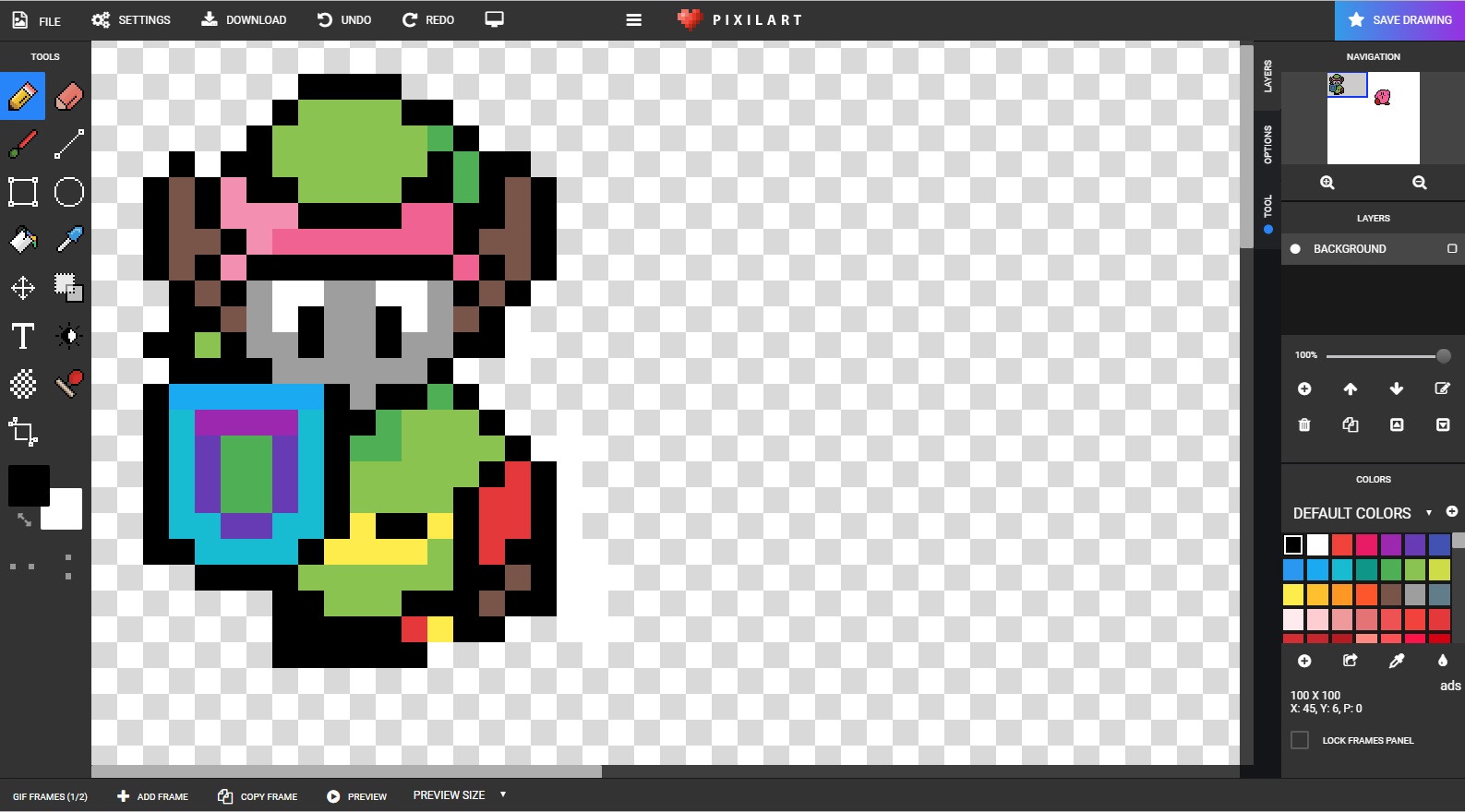
If you want students to create a digital version of their work in the Pixel Art format, then you’re going to need some tools to do so. I used PixelArt.com, however, you need to be aware of the drawbacks with using a free website like this:
There are ads that regularly pop up (I didn’t see any inappropriate ads during my time using this website)
Like the coding website Scratch, there is an online community of users
Students can import various templates (sprites/backgrounds) to use in their work
I didn’t see any inappropriate templates when the students were creating their artwork; however, I cannot guarantee that they don’t exist on this website. PixelArt.com does have an online community and whenever you have an online community you cannot guarantee a ‘G’ rated viewing experience. I browsed through the online gallery and I recommend that primary school students don’t access this part of the website.
PixelArt.com claims to monitor this content, however, the content that is in some of the galleries is still inappropriate. See the image down below regarding what precautions Pixel Art.com takes when monitoring community behaviour.
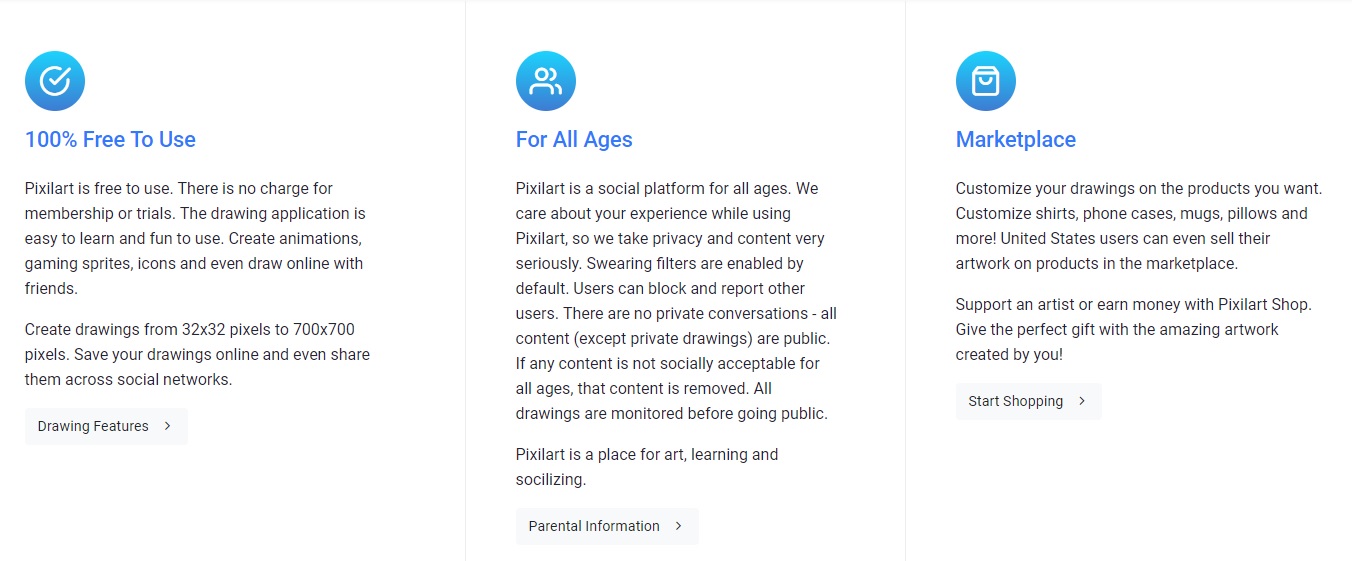
To get around this concern of mine, I kept the students to the draw page and they had to inform me of when they were using the website. Make sure you are doing your due diligence by closely monitoring the classroom whenever your students are the internet. I never permit my students to message anyone or leave comments on a webpage. The only exception to this rule is when they need to send an email to a fellow student from their email account and the email must be school work related.
Students can save their design as a as ‘.pixel’ file on their computer and they can also download their final image as a ‘.png’ file.
2nd Recommendation for Digital Designs - Brik.co
Another option, that is less advanced than PixelArt.com is Brik.co. There are less features to use for your Pixel Art, however, it doesn’t have the constant ad popups. BRIK is perfect for single image sprites that students want to create. You cannot create moving sprites, but their Pixel Art website does have an awesome trace image feature with their online creation tool.

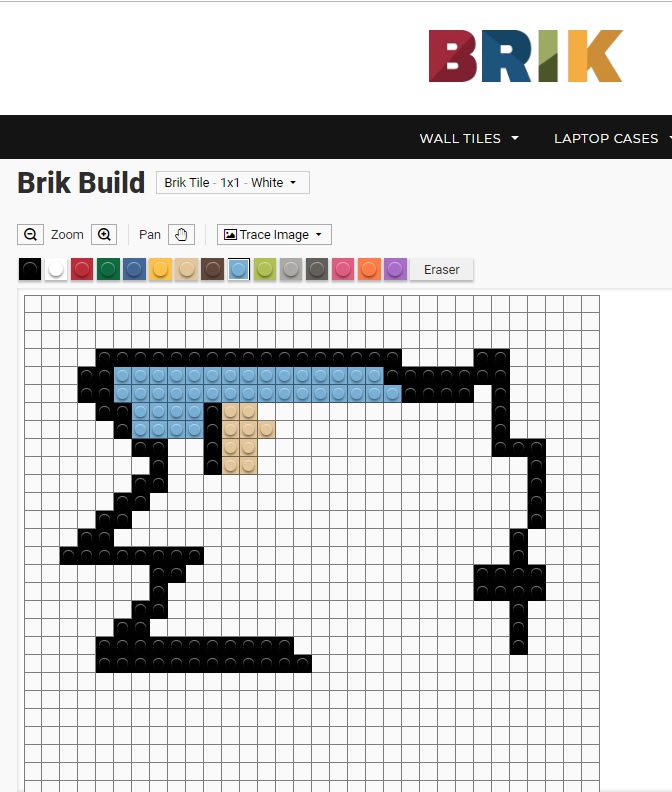
Unfortunately BRIK does not allow you to save your work; however, once students have created their single sprite image, they can always screenshot this image as a way of saving it.
BRIK also has an online community and there is a gallery for Pixel Art. I haven’t come across any inappropriate Pixel Art images on BRIK; however, make sure you have a closer look at this part of their website. Please keep in mind that BRIK is a company that also sells BRIK related product such as greeting cards, laptop display panels and marble runs.
HOW YOU CAN USE EXCEL TO CREATE PIXEL ART
During term 3 2020, I can across a fantastic YouTube channel called Technology for Teachers. I have embedded a video which shows teachers how they can use Excel to create Pixel Art. I highly recommend that you take the time to watch this video.
FINAL THOUGHTS
Even though I finished this unit of work 10 weeks ago, students regularly ask me if we can create Pixel Art images again. I occasionally find students of mine making Pixel Art images in their spare time and I still come across students who bring in images that they have created at home. Just on this fact alone, you could say that this unit of work was very successful. It’s an absolute joy to see students using the skills you have taught them; it’s even better when you see them use this knowledge to make even more advanced Pixel Art images and animated character sprites.
Thank you for reading this week’s blog and I hope you are now inspired to run Pixel Art in your classroom. If you got something out of ‘How to Successfully Teach Pixel Art in Your Classroom’ then I want to hear from you. Don’t be afraid to reach out to me on social media or send me an email.


IF YOU THINK THIS WEBSITE IS AWESOME THEN PLEASE ...
Bookmark this page.
Follow us on Instagram | @griffin_edu
Like and follow us on Facebook | @griffineducationenterprises
Follow us on Twitter | @Griffin_Edu
Follow us on Pinterest | Griffin Education Enterprises
Join our mailing list down below.
Consider supporting us on Patreon.
And most importantly, share this website with other educators!
3 Strategies to Help Get into a Great Mindset
Need a boost with your mindset?
Then make sure you read this week’s blog.
Over the past few weeks I have undergone a pretty radical change in my mindset, and I suspect this change might be permanent.
So how did I get to this point?
Well I need to go back to the start to explain how.
In the beginning of the year I started to track my thoughts and I wrote down what I was thinking. After I had put pen to paper, I came to the realisation that my thoughts focused on the things that I couldn’t control and that they were largely negative. This realisation was also combined with another thought that I had been dwelling on. Since hitting my mid-30s, I have become acutely aware of the passage of time.
Surely life isn’t just a massive grind before our final breath?
So my wife and I decided to do something different. We decided to pursue the things that captured our interests as opposed to what is expected of us. People would say things like “Matthew, you need to become a deputy principal,” & “Alexandra, you need to finish university and become a teacher.” These things weren’t making us happy, so we took a different path.
For me this included:
Mastering the use of social media
Writing a blog once a week
And more recently, making TPT resources (posters, worksheets)
For her this included:
Writing a book, which means that she is putting university on hold for six months
I haven’t accumulated a large number of followers (just under 2,500), I haven’t quite kept up with my #weeklyblogchallenge and my resources, while good, have only sold five copies, but you know what.
The journey counts more than the destination.
I have immensely enjoyed the journey that these goals have taken me on. I have learnt a myriad of new skills; my professional learning network has expanded enormously, and I just might be the happiest I’ve ever been.
So here are ‘3 Strategies to Help Get into a Great Mindset’.

Gratitude
In 2016 I was unsuccessful with the first stage of the Level 3 Classroom Teacher (L3CT) accreditation process. It’s like becoming a lead teacher/head teacher. Looking back with the gift of hindsight, I realise that I was probably completing the L3CT accreditation process with the wrong mindset. My third child was about to come into this world which meant that money became more of a priority for me. This of course, is an understandable flaw. Who doesn’t want to provide for their children?
Having been through this gruelling process, I’ve realised that ‘money is a poor motivator’.
I thought that my ‘money problems’ would be fixed by achieving this goal and I had gotten the idea into my head that ‘I’ll be happy when [insert goal/idea here]’. Here are a couple of things I’ve told myself over the years:
I’ll be happy when [I GRADUATE FROM UNIVERSITY]
I’ll be happy when [I GET A PERMANENT JOB]
I’ll be happy when [I EARN MY L3CT PROMOTION]
Here’s the thing, at one point in time I wanted to be where I am right now. I was after the permanent job, I wanted to get married and I wanted children etc. I’m sure a lot of people reading this blog are also in the ‘I’ll be happy when mindset’.
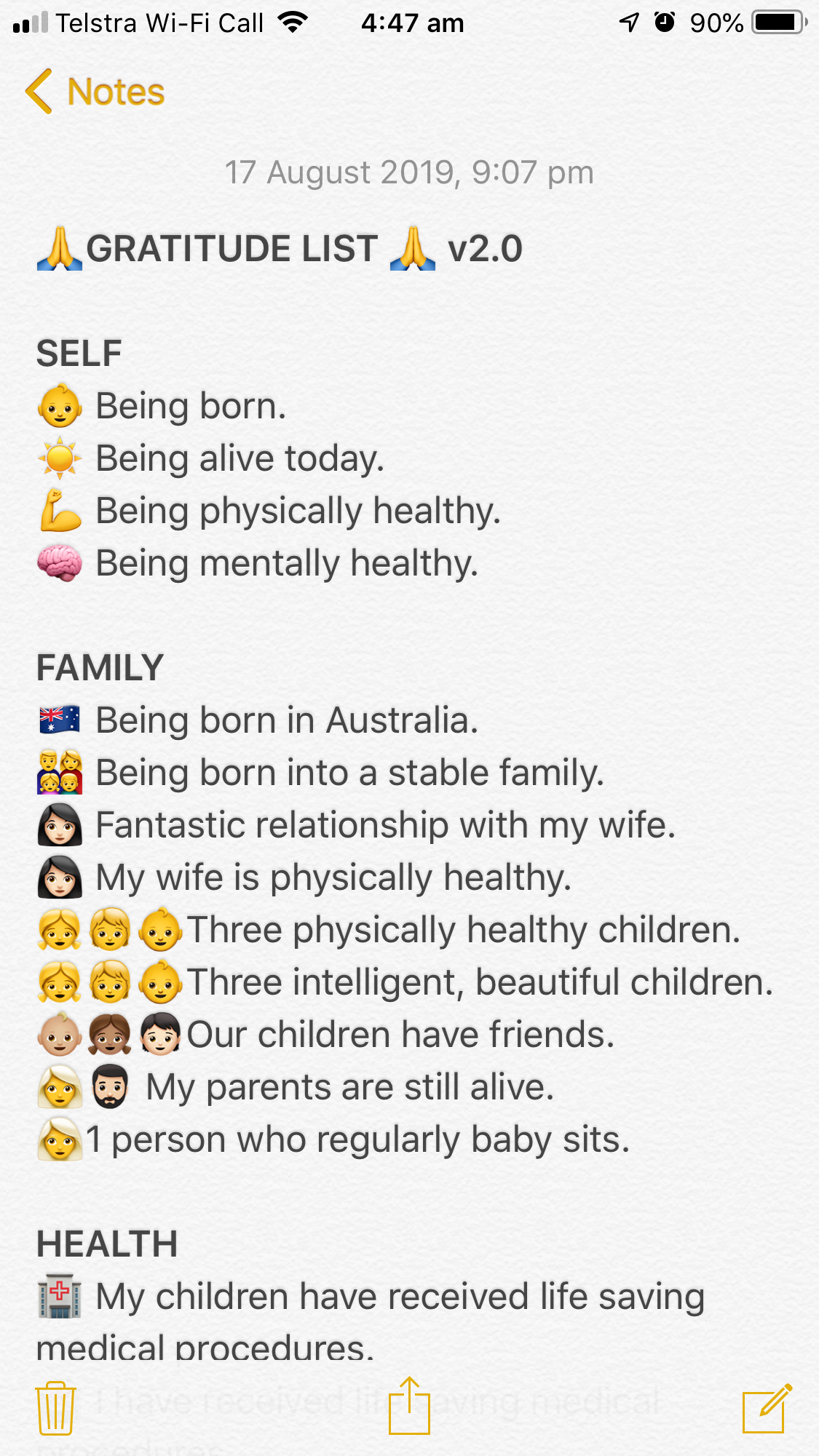
Which brings me back to the word gratitude. One of the best things I’ve done this year was to write a ‘gratitude list’ about all the things that I currently have in my life right now. I wrote down an extensive list of everything that came to mind and then organised them into the following categories:
Self
Family
Health
Work
Lifestyle
I’ve been adding to this list since I started it three weeks ago and I’ve made sure to read it every day. The effect it has had on my mindset and my feelings is noticeable. I have felt happier, my wife has noticed that ‘emo Matt’ is no longer present and my colleagues have also noticed that my general demeanor has changed.
Right now I have never felt more on top of my game as a teacher and practicing gratitude has played a large role in this outcome.


Creating more than you consume
Another key factor that has significantly contributed to my improved mindset is this. I am creating more than I am consuming. Since the start of this year I have been creating:
More video content
All of this content hasn’t just come to me over night. It has taken a lot of ‘figuring out’ to find my niche but also with the marketing of my content. When I was teaching myself about marketing I came across Vanessa Lau, Kerwin Rae, Gary Vaynerchuk, Neil Patel and many others. Their marketing content is amazing and they will also help with your mindset too.

As I mentioned in my introduction, I have enjoyed the journey that these goals have taken me on and the challenges they have provided me with. Here are a range of new skills/outcomes I’ve learnt/achieved as a result of this change:
Improved the quality of my writing and the quality of my blogs (check out my first blog and compare it with this one)
Learnt how to use MS PowerPoint to create resources
Accumulated a great range of commercial resources for TPT creators
I’ve improved the look of my classroom by using my own TPT posters and by using a range of Google Fonts to improve the look of my everyday worksheets that I create
Learnt how to market myself better to a wider audience (using thumbnails, hashtags in social media, when to post etc)
Learnt how to create engaging social media posts; I’ve then applied these skills to my school’s Facebook page to generate more interest (and income) for our school camp fundraiser this year
I’ve expanded my professional learning network
I’ve deeply reflected on my teaching pedagogy
When looking back at these outcomes, it reminds me of the following saying in the picture below.

I could have invested my time into watching Netflix; however, I wouldn’t have achieved even a ¼ of the outcomes I mentioned above.
And that, to me, is a waste of time!
Pursuing what you want to do
This year I ruled out one career option that I was seriously considering for the last two years. I ruled out the career pathway of deputy principal. I was offered a two week stint in the office twice this year. The first offer I accepted but had to turn down due to a family emergency and the other offer I recently declined.
When the 2nd offer of a 2 week stint in the office was put to me, I was uncertain about whether I should accept it or not. I gave myself three days to make a decision and wrote down a rather large list of pros and cons. The point I gave the most thought to was opportunity cost, which is the loss of other alternatives as a result of making a choice. While the extra income would have been great, I couldn’t get pass the time I would lose being in the role of deputy. There were three cons I considered as non-negotiable:
I would have less time for pursuing my goals
I would have to give yet another part of myself to the teaching profession
I would be depriving my wife of time to pursue her own goals since I would be placing an even larger proportion of parenting upon her.
I have established ‘content creation’ as a habit and I don’t want that to stop. I regularly wake up at 4:00am to write, create resources and to network across a wide variety of social media platforms. I don’t want to be ringing and organising relief teachers at 5:30am when I could be focusing on what I love.
Final thoughts
This year has been a life changing year for me. I don’t want to go back to the way I was with my previous mindset and where I was investing my time. If you’ve been thinking about pursuing what you want to do, like pottery classes or learning a new language, then I suggest that you go ahead and do it.
We only have one life to live so you may as well make the most of it.


IF YOU THINK THIS WEBSITE IS AWESOME THEN PLEASE ...
Bookmark this page.
Follow us on Instagram | @griffin_edu
Like and follow us on Facebook | @griffineducationenterprises
Follow us on Twitter | @Griffin_Edu
Follow us on Pinterest | Griffin Education Enterprises
Join our mailing list down below.
Consider supporting us on Patreon.
And most importantly, share this website with other educators!
4 Strategies for Dealing with the Discomfort of Criticism
Don’t like the feeling of discomfort that comes with criticism?
Neither do we! Make sure you check out this week’s blog to find out how.
Criticism.
What an awful word!
Dealing with the discomfort that comes with criticism is something that every teacher must learn to deal with in their own way. This year I have become much better at dealing with criticism. I attribute this progress to two goals I set my self at the start of 2019.
Mastering the use of social media on multiple platforms
Challenging myself to write a blog once a week
These two goals forced me to develop additional strategies to effectively deal with criticism. If you want to be successful at something, then you need to become very comfortable with the idea that not everyone is going to like you. So here are some ideas for what you can do about dealing with the discomfort that comes with criticism.


Teaching isn’t a Popularity Contest
As teachers we have to make some pretty hard decisions that admin, fellow teachers, parents and students are going to hate. Common sources of criticism can come from:
Following up with parents about their child’s low attendance
Giving honest feedback to a parent about their child’s behaviour, especially if they are in denial about how bad things are
Explaining to an irate parent why their child got a low mark
Speaking with admin or a fellow teacher about the direction of the school
Making a report about a suspected occupational health and safety concern
Lodging a police report against a child who physically assaulted you
I could make a 10 page list of all the tough choices we have to make as educators.
Here is my strategy, accept the fact that criticism is part of teaching. I have never met a teacher or principal who wasn’t criticised as a result of doing their job. We will all be criticised at some point in our careers. So if we cannot eliminate criticism then we need to change our mindset, which is the reason why I wrote this blog.
If you’ve never gotten on the bad side of someone at least once as a teacher, then are you even doing your job?
The $86,400 Question

We all have 86,400 seconds in one day, no more, no less.
How many times have you allowed a negative ten second interaction, such as reading a hostile email or receiving a nasty comment, to affect the rest of your day? I know I have been guilty of this on more than one occasion, but the good news is that you can get better at it.
You need to consider an economic term called opportunity cost when deciding if a negative comment should affect the rest of your day. Opportunity cost is defined as the loss of other alternatives as a result of making a choice. Think about these two points next time you’re grappling with a negative interaction:
Did you waste your time and energy thinking about a particular incident?
Did you let this negative interaction affect the time that you spend with your family?
One of the things that helps me move on from unwarranted criticism is this. I like to imagine what else I could put my time into instead of worrying about the inconsequential opinion of someone else. We can always earn more money if we lose it all, we can always get fitter if we want to; however, we cannot get back our time.
Spending an excessive amount of time on the negativity of someone, who is most likely an a**hole, is a choice and a massive waste of time. The simple fact is that I REFUSE to pass on these emotions to my family.
At the end of the day, it is a CHOICE whether you decide to take on the negative emotions that someone else is giving off.
Losers Focus on Winners, Winners Focus on Winning
I recently came across this quote and it’s easily become one of my top three favourite quotes of all time.
If someone, let’s say a teaching colleague or a stranger, is criticising your ability as a teacher, you need to think about whether their opinion matters. You need to think about what they’ve done throughout their career/life. Here are four questions to ask yourself in this situation:
Do they complain but never offer solutions?
Have they played things safe their whole life?
Have they never taken a risk or done something unique in their teaching career?
Have they taken the risk, failed and then become bitter about the whole learning experience?
If you’ve answered yes to these questions, then chances are you have someone who is a loser and guess what losers do? Losers focus on winners.
I’ve been criticised quite a few times since publishing my blogs as part of my #weeklyblogchallenge. You’d be surprised at how many people cannot have a civil debate on social media without resorting to nastiness or ad hominem attacks! When I receive criticism from someone on the internet, I check out the critic’s social media profile and evaluate them against the four dot points above.
And guess what happens most of the time?
“People see what they want to see and what people want to see never has anything to do with the truth.”

Credit @LUTHEGOLDEN
Embrace Failure
Based from my previous strategies, you can be forgiven for thinking that I might use these as a crutch for not changing the worst aspects of my character. One thing I’ve learnt from teaching is to openly embrace your failures, especially when you’ve been provided with feedback by a critical friend or a critical stranger.
If you’ve read through some of my previous blogs like, ‘How to Use YouTube Safely in Your Classroom’ and ‘Why the Result I Received for my Level 3 Portfolio is Questionable’, then you’ll know that I’ve made my fair share of mistakes. Failing to pass the first phase of the Level Three Classroom Teacher accreditation process is a pretty big failure but in failure lie the lessons for future success. So I decided to publish my mistakes on the internet. By taking this step, I received the necessary feedback about my level three portfolio and went from ‘Bitter to Better’.
I didn’t let my mistake with using YouTube in the classroom fester into an experience that I wanted to keep locked away, like the proverbial skeleton in the closet. Instead I looked into additional resources with how to use YouTube safely and I came up with an even better procedure for showing videos in the classroom.
Time and reflection = learning from mistakes.
Final Thoughts
The discomfort of criticism is something we all must learn to deal with in our own way. It’s important to keep in mind who is critiquing you next time you are faced with criticism e.g. I’d place a much higher value on criticism from Jennifer Gonzalez, the ‘head teacher nerd’ from Cult of Pedagogy than the criticism of Joe Bloggs who thinks education is ‘stuffed’.
There is nothing worse than wasting time thinking about the negative opinions that others have about you. If you truly place a high enough value on your time, then you won’t allow the discomfort of criticism to cloud the majority of your day. Your time is valuable and there are so many other important things you could be doing instead of focusing your energy on what other people think about you.
IF YOU THINK THIS WEBSITE IS AWESOME THEN PLEASE ...
Bookmark this page.
Follow us on Instagram | @griffin_edu
Like and follow us on Facebook | @griffineducationenterprises
Follow us on Twitter | @Griffin_Edu
Follow us on Pinterest | Griffin Education Enterprises
Join our mailing list down below.
Consider supporting us on Patreon.
And most importantly, share this website with other educators!
My Journey Down the Braille Teaching Niche on Instagram
Interested in learning more about the Braille teaching niche?
Then make sure you check out this week’s blog as part of my #weeklyblogchallenge
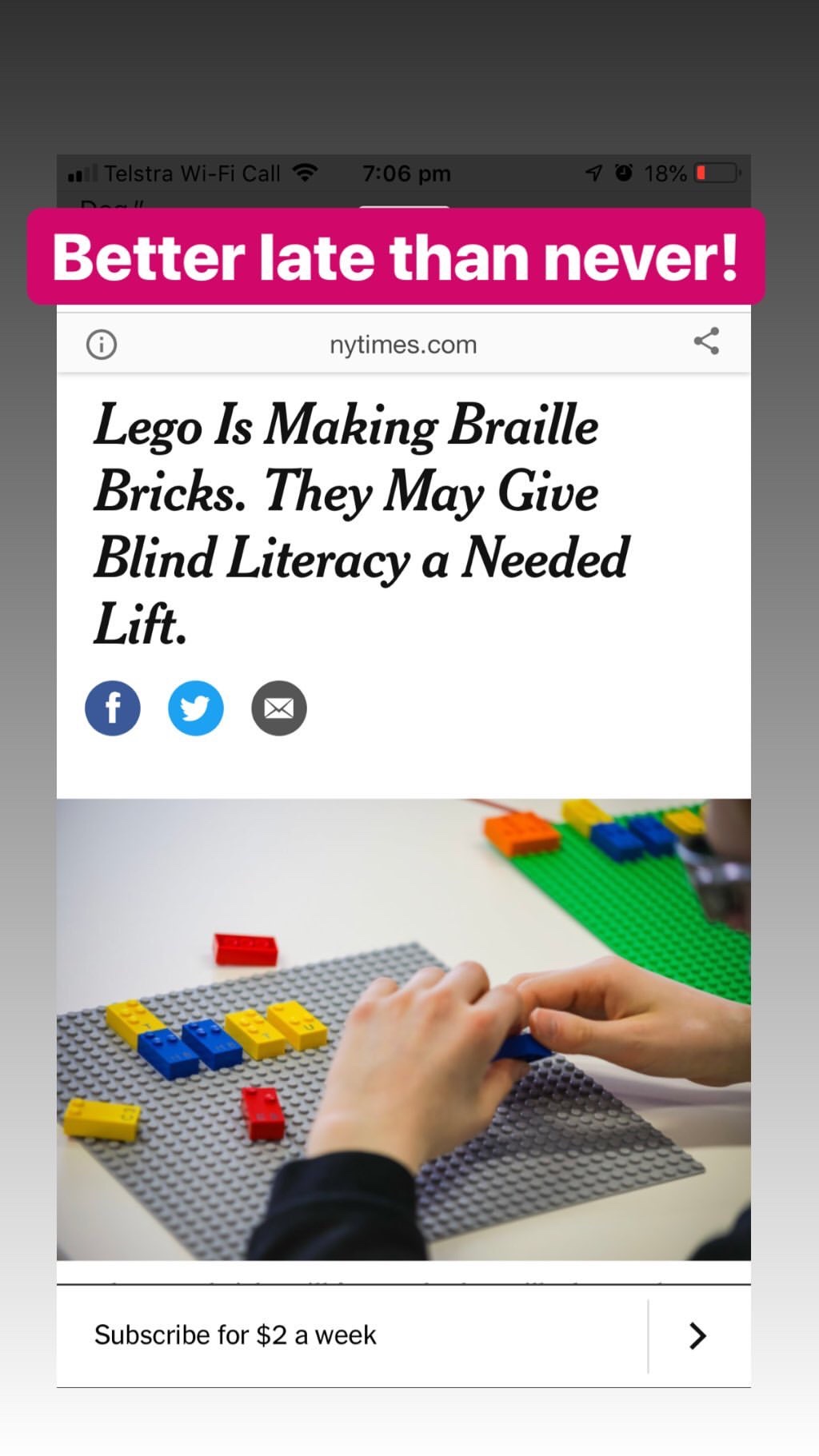
There was a newspaper article that caught my attention during the first week of my term two holiday break. The article in question, Lego Is Making Braille Bricks, is self-explanatory; however, it was fascinating to read for another reason. This article details the struggles that some parents go through to access specialised help in order to teach their children how to read Braille. I suggest that you go and read it for yourself after finishing my blog. The main points of the article include:
There is a preference to teach blind and sighted children in mainstream classrooms as part of a policy to offer equal education to children with disabilities
It appears that this policy has created an overreliance on audiobooks, apps and screen readers when teaching blind and sighted children
It is estimated that only 10% of blind children know how to read Braille
10%!
You read that right!
Essentially, assuming these estimates are correct, 90% of all blind and sighted children are illiterate and CANNOT READ! It is absolutely outrageous that 90% of a disabled cohort of students, who are very capable students, cannot read, and if they cannot read then they cannot spell, and if they cannot spell then they cannot write.
Imagine all of these students missing out on the joy of reading.
It seems the struggle to provide the necessary services to teach blind children how to read Braille is not just limited to the US but also Australia. Perth mother Racquelle Hannen-Williams had to fight incredibly hard to get her twin daughters, who suffer from a degenerative condition called optic neuropathy, more tuition time to teach her children how to read Braille.
What we have here is a massive issue about equity for students who are blind and sighted. The common thread amongst both articles is that these children were fortunate enough to have parents who were willing to fight tooth and nail to demand the most basic of services to help their children with reading Braille. It makes you wonder how many other blind children, who don’t have supportive parents, end up missing out on the joy of reading.
It shouldn’t have to be this hard.
WHAT I’VE LEARNT ABOUT BRAILLE
Another thought occurred to me after reading this article.
I didn’t know the meaning of a single Braille cell.
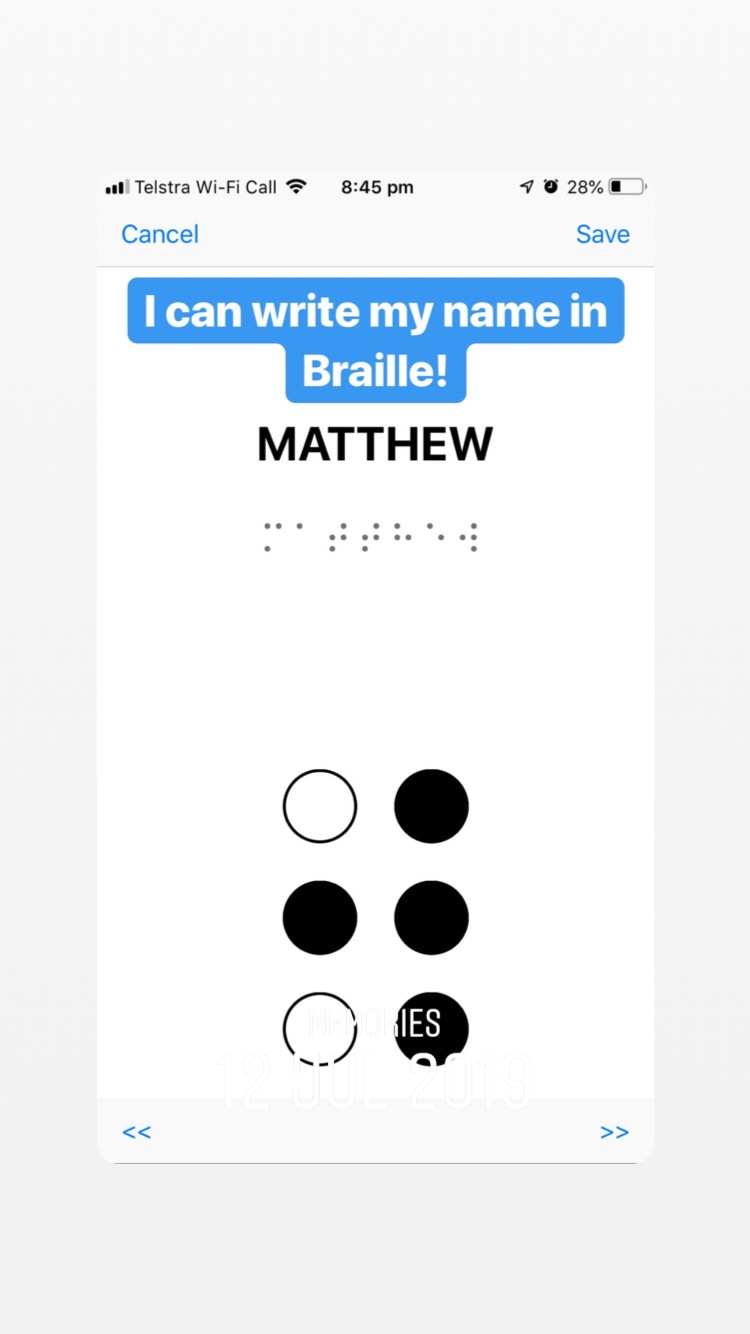
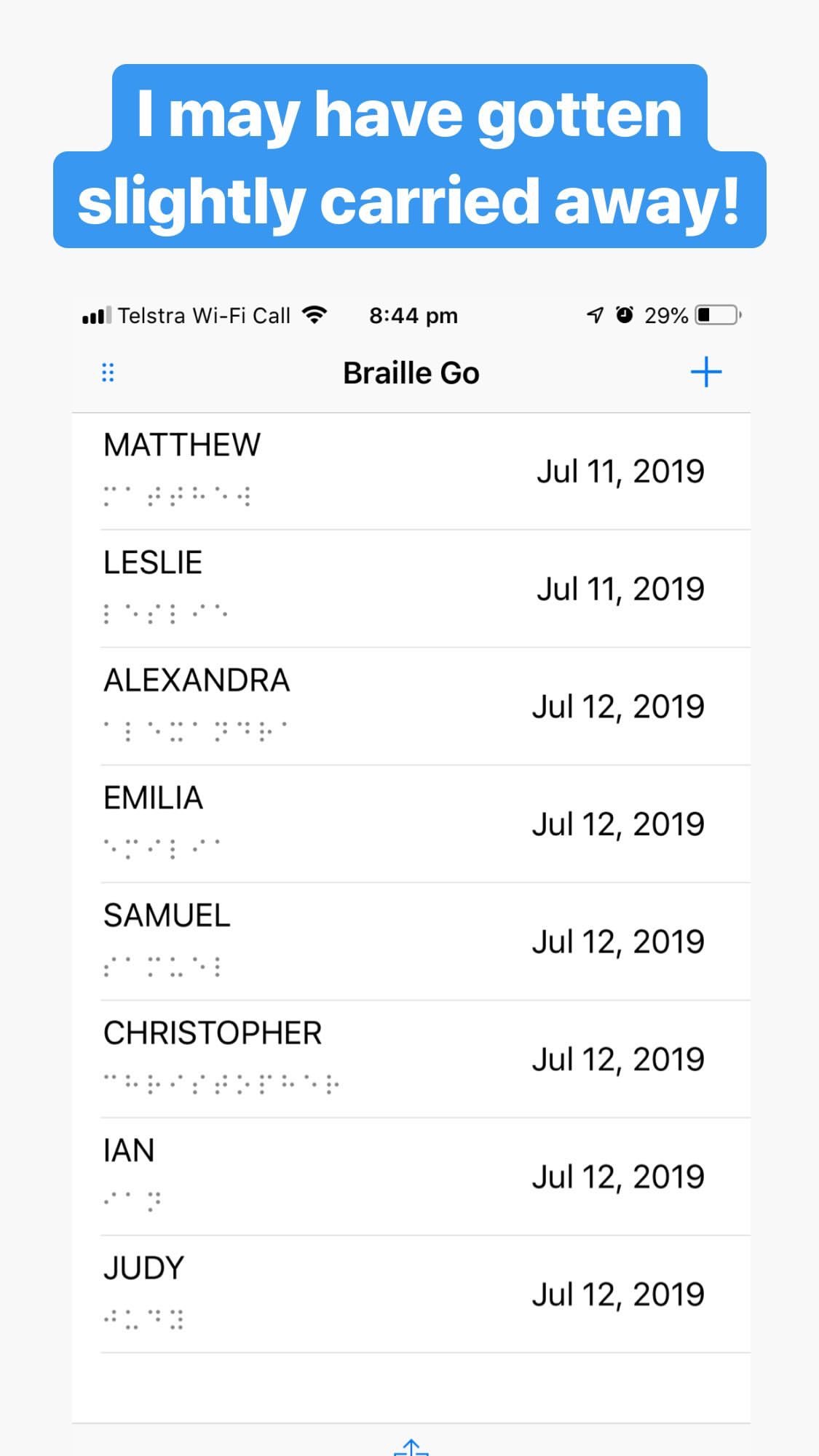
I can speak German at a primary school level, I know many words in multiple languages, I can even make a handful of AUSLAN signs; however, I didn’t know a single letter of the Braille alphabet. To be honest I was quite embarrassed at this unfortunate fact. If I was going to make a difference, then I needed to learn as much as I can about this language system.
So, here is what I learnt after reading through a variety of social media accounts, YouTube channels and other online articles:
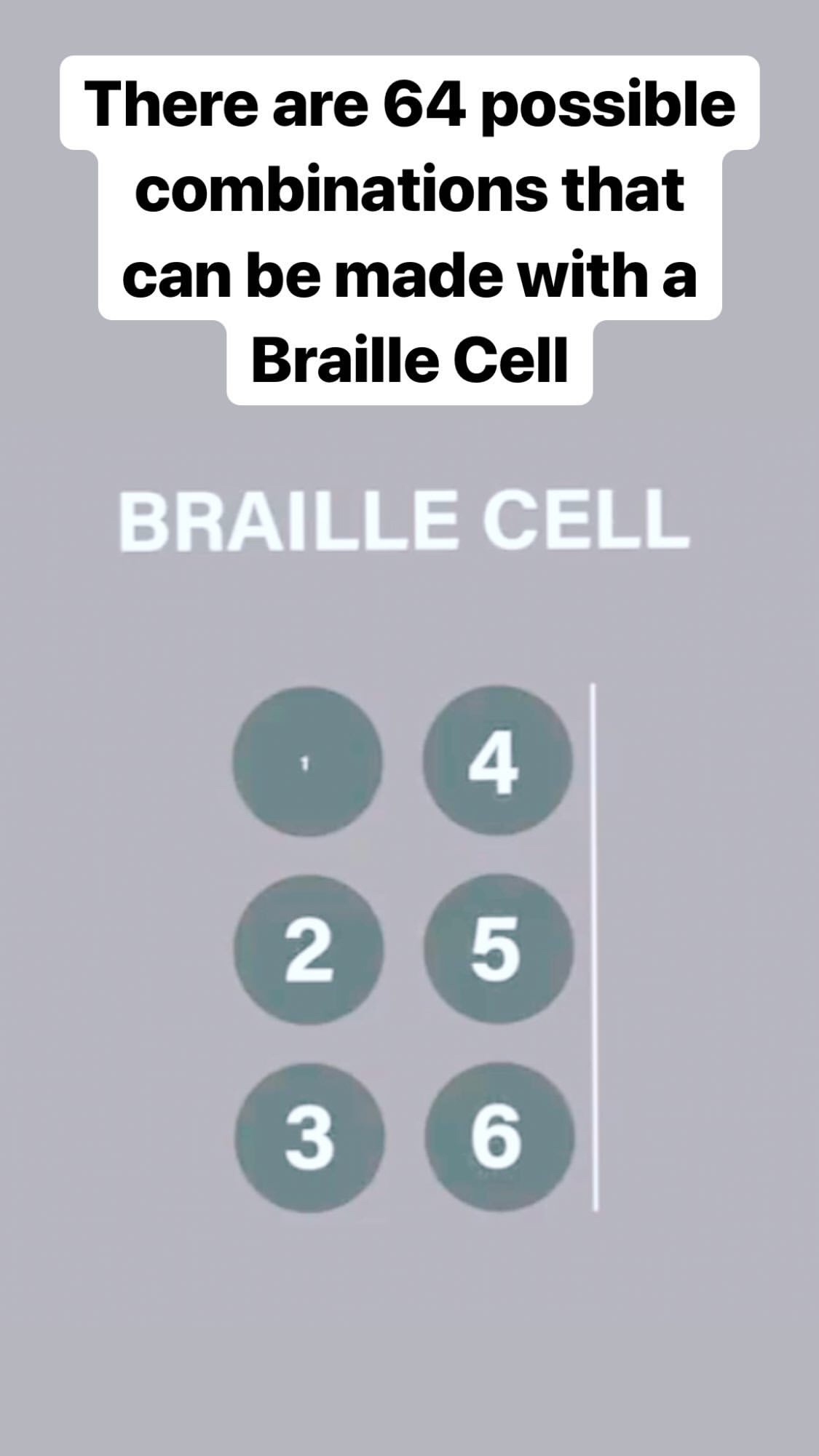
A single Braille cell (2 x 3 small rectangular shape) consists of six raised circular etchings
A single cell is large enough for a fingertip to feel what is written down
There are 64 possible combinations with the Braille single cell
There are markings that instruct students when they are no longer reading individual letters but are reading numbers and contractions
The French army used a precursor to Braille in the early 1800s as a way of reading orders at night without using a light source
Blind French teenager, Loius Braille, modified the French army’s Braille code to the single Braille cell system that is universally used today
Blind students write using a Braille Perkins, it’s like a type writer for the blind.

BRAILLE PERKINS
I came across an incredibly funny YouTube channel called ‘The Tommy Edison Experience’. Not only does Tommy do an excellent job detailing how he uses a Braille typewriter, but he also has a range of videos explaining how he goes about his everyday life. I highly suggest that you follow him on YouTube and Instagram.
EXPOSE YOUR STUDENTS TO BRAILLE
I am of the view the Braille is an under appreciated language system that is in dire need of promotion within society and our education system. This term I’ll be doing my part and exposing my students to Braille as part of an ice breaker activity as something I can do to raise the profile of this language system within my sphere of influence.
If you want to make a difference, then I suggest that you consider doing the same as well.
FINAL THOUGHTS
What surprised me about my journey down the Braille ‘rabbit hole’ on Instagram is this. Why haven’t these things, like LEGO Braille bricks, already been implemented. Why hasn’t Google added Braille to one of their translatable languages? Imagine if they actually did this! Imagine how this action would help raise the profile of Braille and make this language system more accessible to everyone. Just because Braille is predominately used by the blind and sighted doesn’t mean it cannot be use by those of us with perfectly functional eyes.
I don’t expect everyone to fluently read Braille but at least knowing more about the language system would be a great start.

IF YOU THINK THIS WEBSITE IS AWESOME THEN PLEASE ...
Bookmark this page.
Follow us on Instagram | @griffin_edu
Like and follow us on Facebook | @griffineducationenterprises
Follow us on Twitter | @Griffin_Edu
Follow us on Pinterest | Griffin Education Enterprises
Join our mailing list down below.
Consider supporting us on Patreon.
And most importantly, share this website with other educators!
My Working Hours for Term 2
Ever wondered how long you spend working at school and from home?
Then make sure you read this week’s blog.
On the 5th of May 2019 I published a blog titled ‘How Many Hours Do Teachers Spend at School on a Typical Day’. In answering my own question, I estimated that I spent about 9.5 to 10 hours at work; however, I didn’t have any concrete evidence to support my claim.
So, it got me wondering; how many hours do I actually work in a typical term?
At the end of term one, I committed myself to this challenge and wrote down all of my start times and finish times for term two. If I was going to complete this challenge, then I needed to follow some rules and I came up with the following:
Work started the moment I parked my car in the car park. If duty of care is active while I am present on school grounds, then I think it’s only fair to consider this as when I start work.
Work ended the moment I entered my car or when I finished a work related task off site e.g. professional learning, purchasing resources for the school etc
I haven’t included any time I spent writing my teaching blogs or pursuing my own education-related interests
I get a lot of teaching ideas from social media; however, I haven’t included that as ‘work’
With these rules now out of the way, lets look at ‘My Working Hours for Term 2’.
CIRCUMSTANCES TO TAKE INTO CONSIDERATION
There are a couple of things that I would like the reader to consider when interpreting my hours at school. I am the sort of teacher who prefers to complete all of my work at school. I cannot play the graduate teacher’s game and spend endless hours of my time at school. I have a family to provide for and every minute of my time is precious.
I also believe in putting in minimum effort for maximum results.
This statement doesn’t mean that I’m lazy, it means that I value my time. If there is a task that can reduce my workload, like editing my reports using text to speech or using Google forms to automatically mark my multiple choice questions, then I’ll implement these strategies to save myself some time. We only have one life to live and I don’t want to give yet another part of myself to my job.
Other circumstances that need to be taken into consideration include:
I have long service leave that needs to be used up by the end of this year
I am married and have three young children who have their own routines
My wife is studying at university and she works as well
I tutor after school on most weekdays and on Saturday
START AND LEAVE TIMES
Every teacher is different when it comes to working from home, especially when you have children of your own. No matter what choice you decide to make, the work still needs to be completed, whether it would be at home or at school.
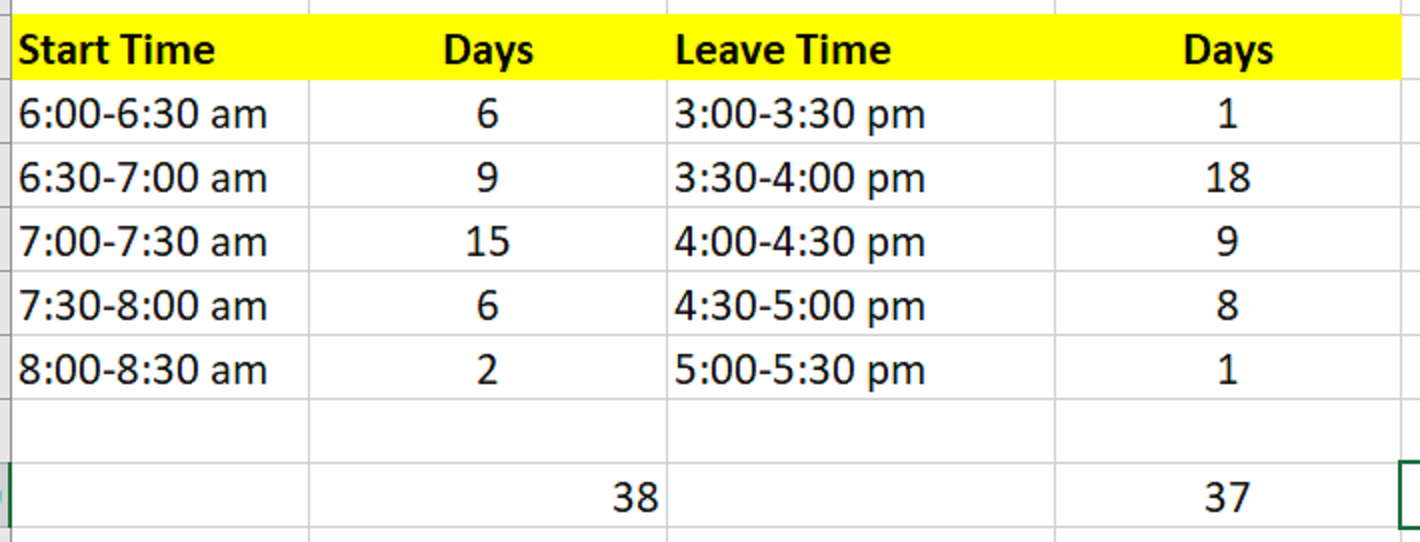
START TIMES

LEAVE TIMES

I usually arrive at school between 6:45-7:30am and I leave between the times of 3:40-4:30pm. As you can see from my start times, I love getting to work early. It’s the most productive time of the day and I can get about 1.5 hours of uninterrupted work done. I also like to get to work early for another reason.
I get the photocopier all to myself.
I don’t know about you, but I get an overwhelming feeling of joy being the first one to arrive in the teacher’s carpark knowing that I can print off everything I need for the week without waiting in line.
STOP COMPLETING YOUR MOST IMPORTANT TASKS IN THE AFTERNOON
I’m going to say something ‘controversial’ to provoke a response from the teachers who:
don’t complete any work from home in the morning and
who prefer to work long hours in the afternoon
I adamantly believe your best work is NOT completed after 3pm, in fact it’s probably the worst time to complete work. If you’re one of those teachers, I’d like you to think about my statement for a moment and consider the following points about working in the afternoon:
you’ve just completed 6-7 hours of mentally draining work
you’ve had to make hundreds of decisions in your classroom
you’ll have parents who need to speak to you
admin will most likely try to ask you a question or two
your teaching buddy will want to come by for a chat (I’m looking at you Miss B 😉)
If you’re trying to write a school policy or a portfolio for a promotion, any momentum that you build will be lost to these five ‘work vampires’. There is nothing more frustrating than having an important and urgent task to complete and being interrupted.
I suggest that you schedule your less mentally draining work for the afternoon. Think of work that can be resumed quickly despite an interruption. For me, this includes any tests or workbooks that need to be marked along with replying to emails. I’ve found that it’s not that hard to get back into the groove of these tasks if someone needs to speak to you.
So, make sure you schedule your most important work for the morning!
MY TIME SPENT WORKING AT HOME
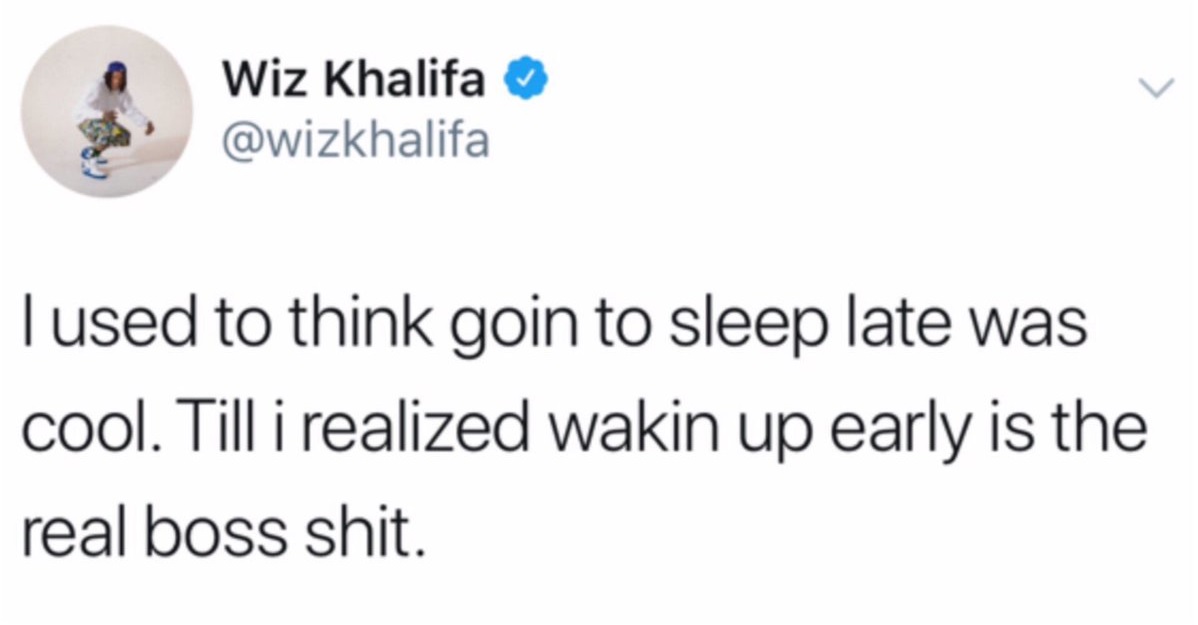
At the start of my teaching career, I used to complete most of my work after school. After reading some articles about the work habits of successful entrepreneurs I decided to change things up to get the most out of my days. This included getting to bed earlier (9:00pm) and waking up at 5:00am. I also changed my lifestyle for another far more important reason.
I want to be fully present for my family when I come home.
I’ve recently claimed my home back as a ‘work free sanctuary’ and it’s one of the ‘6 Parameters I Set Myself to Prevent Teacher Burnout’. You don’t get back the time you spend at work and to be honest, I don’t look back fondly upon it. In fact, I resent it on some level but that’s the price we pay to survive in this world.
What you will look back fondly upon is the time you spent with your family. My nine year old daughter is growing up right before my eyes and I often think to myself ‘where has all the time gone?’ I cannot think of any stakes higher than this and you only get one chance to raise your children correctly.
Don’t get me wrong, I love my job, but I love spending time with my family and pursuing my own interests more than work.
MY TOTAL HOURS WORKED THROUGHOUT THE TERM
Now for the part that we’ve all been waiting for, my average time spent working each day.

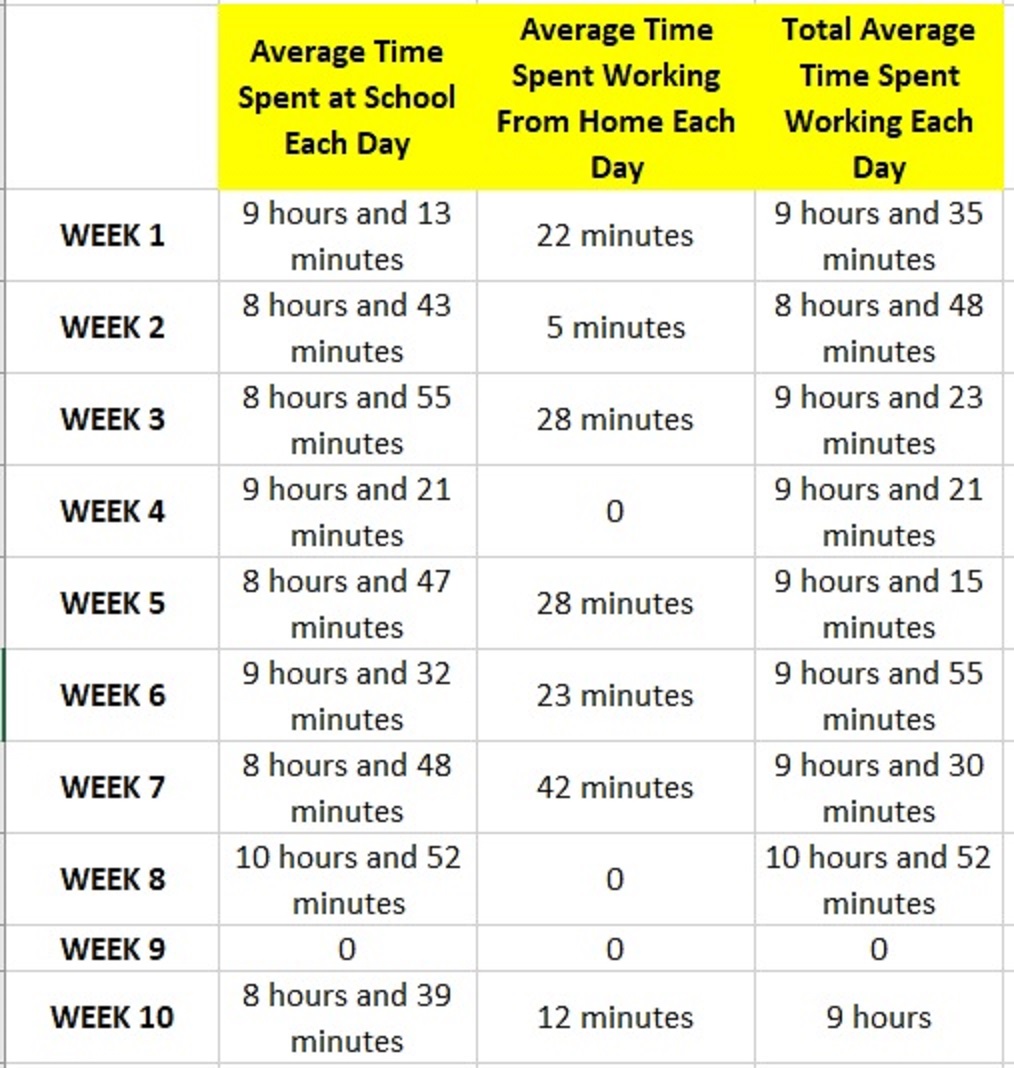
I needed to take two weeks of leave in order to take over the parenting responsibilities of my three young children while my wife spent time assisting a family member with a medical emergency. The staff at work were amazing in reorganising the school in my absence and I’m incredibly grateful for the support they provided.
Sometimes life happens and there is nothing that you can do about it!
Back to the blog. As you can see, the majority of my work stays at work and I couldn’t feel prouder of this achievement. I took the odd day off here and there since I’m required to use up all of my long service leave within two years. I usually spent between 9-9.5 hours on work each day. My longest days were on the 13th of June (12 hours and 3 minutes) and the 12th of June (11 hours and 18 minutes), all of which revolved around adhering to a reporting timeline. Contrary to popular opinion, there was only one day where I worked ‘school hours’ and that was on a professional learning day. Even during the final week of term two I was averaging 9-hour work days.
I hope you have enjoyed reading this week’s blog. If you are curious about the time you spend at work, then I challenge you to do what I’ve done and write down your start and leave times for an entire term. I cannot think of a better way to regain your work-life-balance if you’re reconsidering how much time you spend at work. It will certainly help you to re-evaluate your priorities in life because after all …
There is more to life than just work.
APPENDIX
IF YOU THINK THIS WEBSITE IS AWESOME THEN PLEASE ...
Bookmark this page.
Follow us on Instagram | @griffin_edu
Like and follow us on Facebook | @griffineducationenterprises
Follow us on Twitter | @Griffin_Edu
Follow us on Pinterest | Griffin Education Enterprises
Join our mailing list down below.
Consider supporting us on Patreon.
And most importantly, share this website with other educators!

4 Ways to Provide Your Students With Opportunities for ‘A’s
Ever wondered how you can provide your students with opportunities for ‘A’s?
Then make sure you read this week’s blog as part of my #weeklyblogchallenge!
If you’ve ever taught in a low socio-economic index (SEI) school, you’ve probably wondered if it’s possible to provide your students with opportunities for ‘A’s. If you have, then you’re more than aware of the wide range of abilities in your school. In these schools you will teach:
students who are incredibly bright and students who struggle to read.
students from functional families who have invested time and energy into their children and students from dysfunctional backgrounds whose only safe place is school.
So, is it even possible to provide opportunities for ‘A’s in this context?
Of course it is!
But it’s not just about providing opportunities for ‘A’s for the ‘clever clogs’ in your classroom, it’s also about providing opportunities for your students to turn their ‘D’s into ‘C’s and their ‘C’s into ‘B’s. The way that we achieve this lofty goal is simple, to just use good teaching pedagogy. If good teaching works in low SEI schools, then it’ll work in your ‘leafy green’ schools.
Good teaching works for everyone.
So here are ‘4 Ways to Provide Your Students with Opportunities for ‘A’s.
Use Your Rubrics
I am of the view that rubrics are one of the best assessment tools that you can provide your students with to show them how they can improve the quality of their work. I’ve found that spending the time explaining how rubrics work to your class, then backing this up with examples of ‘A’s, ‘B’s, ‘C’s and even ‘D’s, helps them to critically evaluate their work.
If you are a teacher in WA, then I suggest that you incorporate the language from the judging standards into your rubrics. For example, one of the key indicators of an A for writing in English is the use of sophisticated vocabulary. Using this sort of language within the criteria of your rubrics will help you and your students when it comes to evaluating the quality of their work.
So, break out those judging standards and start rewriting your rubrics if you haven’t already done so.
Use Opened Ended Questions in Your Tests
For my Science and HASS tests, I like to use multiple choice, short answer and extended answer questions to determine what my students know about these learning areas. In my experience, multiple choice and short answer questions usually indicate a student’s ‘breadth’ of understanding; however, an extended answer question will show you a student’s ‘depth’ of understanding. Here is an example of a question I use in History to show a ‘depth’ of understanding about Federation.
What if Federation Never Happen? How would Australian history be different? What problems would still exist if Australia never federated?
Open ended questions like this are a great way to see how well a student can critically evaluate what they’ve learnt and then apply it to a hypothetical situation.
If there ever was a way to use Bloom’s taxonomy in your classroom then this is it!

Use this Innovative Testing Feature
Earlier this year I came across an amazing idea that was posted onto the Facebook page Teacher2Teacher. The post in question showed a picture of a student’s science test. Nothing remarkable was on this page apart from the question that was asked, and this question read:
‘Everything I know about this topic but wasn’t asked on the test’.
Whoever came up with this idea was an absolute genius!
They say ‘imitation is the sincerest form of flattery’ so I decided to implement this idea for my HASS test on Federation in term one of this year. One student’s response that gave me a good laugh said, and I quote, ‘Mr Leslie said that WA stands for ‘wait awhile’ because we were the last state to federate’. I also had one student who researched Tasmania’s perspective on Federation in their own time and included several facts about this. I can confidently say that this testing feature helped enormously when it came to allocated grades to my students in history this semester.
On a side note, using something like this for scoring can be tricky. How can you score something from a response that you cannot anticipate for? To get around this problem, I didn’t include the marks from this section as part of the total score, but I did add five extra bonus marks. A student could skip this section if they wanted to and they would not lose marks.
Challenge yourself and add this feature to your tests. I promise that you’ll be pleasantly surprised at your students’ responses.

Allow Students to Resubmit Assignments
For the past two years I have been allowing my students to resubmit their persuasive texts and narratives that they write independently as part of my homework routine. I never used to assess written tasks in this manner until I came across an educator called Dr Justin Tarte. I used to see these writing assignments of mine as a formative assessment that was absolutely set in stone, almost like a piece of work that was to be marked and never looked at again.
By doing things differently, I now allow my students the chance to resubmit their work after I have provided feedback on their first submission. I also up the stakes on their resubmission by telling the students that I will consider their resubmitted text as an original piece of work that won’t be held back by the quality of their first submission.
I saw a dramatic increase in the quality of work that my students produced after implementing this idea. Even then, there are still parts of their narratives that they could improve on. Next year I wouldn’t mind asking my year five students to use the same characters from their narratives they wrote last term as part of a new chapter to build upon.
In fact, I am going to do this!
It takes a while to see where you can provide opportunities for ‘A’s, but the moment you open yourself up to this idea, you’ll eventually reach a creative space that helps you to achieve this goal. I hope you have enjoyed this week’s blog and I hope that it prompts a change within your own teaching pedagogy!
IF YOU THINK THIS WEBSITE IS AWESOME THEN PLEASE ...
Bookmark this page.
Follow us on Instagram | @griffin_edu
Like and follow us on Facebook | @griffineducationenterprises
Follow us on Twitter | @Griffin_Edu
Follow us on Pinterest | Griffin Education Enterprises
Join our mailing list down below.
Consider supporting us on Patreon.
And most importantly, share this website with other educators!

8 Reporting Hacks for Teachers
Want to save time on long it takes to complete your reports?
Then make sure you read this week’s blog. You won’t regret it!
Reporting is one of the most time consuming, laborious tasks that a teacher must complete every semester. But say If I told you that there are steps that you can take to:
Produce higher quality reports and
Finish your reports faster than ever before
Sounds too good to be true doesn’t it?
I’m not saying that writing reports isn’t a lot of work; however, with these eight reporting hacks I have managed to save myself a lot of time, time which I have been able to spend elsewhere. So, in this week’s blog as part of my #weeklyblogchallenge, I’ll be sharing with you ‘8 Reporting Hacks for Teachers’.
Let’s get started shall we!
Start the process early
An ideal time to start writing reports is just before the end of term one. Now, this statement doesn’t mean you have to have all your comments completed by the end of term one but starting them early pays off enormously. A good place to start is with your general comments since they are usually the hardest ones to write but can be started the earliest. Even having a rough outline with dot points for each student’s general comment is a great start to make before commencing term two!
So why start this early? Well, it takes me about a week or two before I get into the groove of writing report after report.
Think of starting reports as a steam train. A steam train takes a lot of time and energy to get going but once it establishes enough momentum then it’s nearly unstoppable. By starting the necessary prep work earlier means you’ll have established the momentum you need to get the task completed sooner.
I know of some teachers who start their general comments as early as week 8, term 1 and they’ll have these comments completed by the end of term one’s school holidays. I am not as organised as these teachers but starting your reports earlier makes a lot of sense. The worst thing that could happen is that a student’s behaviour changes and you’ll have to rewrite part of the comment. In my experience I’ve only ever had to change a maximum of 1-2 general comments per reporting cycle.
Imagine all of the stress you’ll avoid if you consistently use this strategy!
Use batching during the writing phase
One of the best strategies you can use during the writing phase of reports is to pick a subject area and then write all your students’ comments for this area over a few days. For example, if you are writing Maths comments then stick to writing Maths comments. This strategy is known as batching, which is completing similar tasks one after another. Once you have completed a couple of reports then it won’t take you long to hit your writing groove for this learning area.
So why should you write your reports in this manner?
Getting into the creative space to start writing comments takes time and energy. Remember the steam train analogy I spoke of earlier? Don’t write your reports by following your classroom’s attendance role in alphabetical order. This means that you will be writing a general comment, then an English comment and finally a Maths comment in one go. This reporting style is no different to driving a manual car in the first two gears then going back to the first one when you should be cruising along in fifth at 100km/per hour. Teachers who do this are denying themselves the chance to make any momentum on their reports!
So, start batching those comments and save yourself some time!
Develop a reporting structure
Another way to build momentum is to develop a reporting structure and stick to it. Let’s use my Maths reporting structure as an example. Please keep in mind that my school asks its teachers to keep their learning area comments to a maximum of 600 characters and that I am an upper primary school teacher (year 5/6). I did not like this change to begin with, but it makes a lot of sense because the grade does most of the talking and writing long comments for each student is a workload issue.
I like to use the following structure:
A comment about how they are generally going in this learning area
Two sentences about how they have progressed in the number and algebra strand
A sentence (or two) about how they have progressed in the measurement and geometry strand and in the statistics and probability strand.
Maybe a sentence of encouragement at the end.
Here is an example of a typical Maths comment:
Joe has understood most of the concepts that were taught during Maths lessons. His recall of basic multiplication and division facts have improved and he has worked well during Room 14’s mental Maths routine. His understanding of how to correctly use the multiplication and division algorithms have improved and he has a strong understanding of place value into the millions. He can create bar graphs and line graphs to a very high standard and he can correctly measure the perimeter of 2D objects such as rectangles and triangles. Keep up the good work Joe Bloggs!
If you write your learning area comments to a common structure and then batch them, then you are onto a winning formula and can crack open that bottle of champagne earlier!
Draw upon your own comment bank
Once you’ve completed several reporting cycles, you’ll have built up a collection of comments to draw upon from your comment bank. For example, I might cut and paste a previous ‘A’ level Maths comment or aspects of it into one of my current student’s who is operating at an ‘A’ level for Maths. All you need to do is to:
Change the name
Change around a couple of words/sentences to match the work you have assessed against
Change the pronouns if required
Why should you work harder when you can work smarter?
While you can easily do this for English and Maths comments your general comments should predominantly be pieces of original work to reflect the unique nature of each student.

Use text to speech when editing your work
I cannot speak highly enough of text to speech and how much time it has saved me during the editing phase of reports. If you don’t know what text to speech is, then click here to read my blog about this innovative editing procedure. Nearly all Word Processing applications have text to speech inbuilt within their programs. So, if you have MS Word or Pages then you have access to this.
So why is this my top strategy to use? Well let me tell you about how I used to edit my reports.
Once I had finished my drafts, I would print off a paper copy of my reports and correct them with red pen. I’d make sure there was double line spacing and that the paper copy was double sided. Despite editing my reports on a computer screen beforehand I would always find mistakes within my paper copies. It usually took my 3rd paper edit until I was happy with the final product but even then I would still find mistakes. This process would take 4-5 days of boring work and each day would leave me with a serious case of brain drain.
But no more.
Having used text to speech for the first time with my reports I have reduced the time it takes to edit them by 66% and I completed all my edits within two days. You read that correctly, I saved myself three days of editing.
Amazing isn’t it and I know some of you are saying right now …
‘WHERE WAS THIS BLOG BEFORE I STARTED MY REPORTS’.
Sorry about that ☹
Look at your reports with a different lens
The problem with writing our own reports is that we tend to look at them with our own, biased lens. A good strategy to get used to using is to try to look at your reports from the lens of the parent. I like to ask myself the following questions about my own reports:
Would a parent be happy to read this comment?
Would I be happy to read this report if this was my child?
Does this comment reflect well on my school’s brand?
Have I provided the parent with information about what their child can do?
Is there more positive feedback than negative (if possible)?
By using this strategy, you might hold back on some of your more savage comments that you’ll probably end up wishing you didn’t write.
Use a peer to edit your reports
The problem of proof reading your own work is that you are relying on your own internal voice to help with the editing of your comments. What we read in our head does not always match what is written down on the page. This is where a critical friend comes in handy as they can only go off from what’s on the page, not from what you intended to write about.
While text to speech does make this strategy largely redundant for spotting grammatical errors, a critical friend is still important for providing us with the necessary feedback we need as to whether we are actually providing an accurate snapshot about what the student has achieved throughout the semester.
I don’t think this sort of specialised, contextual feedback could ever be replicated by a machine.
Provide your line manager with a sample of your reports
My final recommendation is to provide a sample of your reports to your line manager a week or two before you reach your submission deadline. The benefit of this strategy is that you can gain an insight into the reporting style that your administration prefers, this is especially important if you have a new deputy principal or new principal who might expect a different reporting style that you are used to. I suggest showing your line manager the following:
A comment where you have made an accurate but potentially contentious statement
A range of comments from your brightest student to your weakest in both English and Maths.
Six comments, two from your General, Maths and English should suffice
The deputy principal’s job is very different to that of a teacher AND this is what makes them perfect for providing the feedback that you need. They are going to see the things that we might miss because they are going to be held responsible in the event that a ‘terrible’ report is released to a parent.
If they make a change, then I suggest that you take it on board. We’re human after all and we’re not always right. We ask our students to be teachable, but can we say the same of ourselves?

FINAL THOUGHTS
Thank you for reading this week’s blog and I hope one of two things happened to you:
Reading this blog confirms that you are adhering to best practice OR
You wish you read this blog earlier and feel like crawling into a ball and crying about all the time you have wasted with inefficient reporting procedures.
If you have any feedback or comments of your own then feel free to send me an email or leave a comment for me on social media.
IF YOU THINK THIS WEBSITE IS AWESOME THEN PLEASE ...
Bookmark this page.
Follow us on social media.
Share this website with other educators!
Help us out by rating our free products on TPT!


When to pick your battles, when you must absolutely have them and how to prevent them.
Struggling with behaviour management?
Then make sure you reading this blog!
Every teacher will hear the phrase ‘pick your battles’ at some point in their career. While this is great advice, unpacking this phrase can be an incredibly complex task. This is the reason why it took so long to write this blog. So, when do we pick our battles? When must we have them and how do we prevent them as much as humanly possible?
The next question you might have is what makes me an authority on such an important topic?
Well, I have received positive feedback from staff stating that ‘your behaviour management is ridiculously good’ and that I have the ability to win over even the most challenging of students. This comes from education assistants that I have worked with, from my line managers and from behaviour management experts from SSEN-B. While I have a lot of practical experience please keep in mind that I am only offering my opinion of what works.
To provide more context to the reader, when I refer to students, I am referring to challenging students. I would classify challenging students as students who have anger management issues, students who are disengaged with formal education and students who have been diagnosed with oppositional defiance disorder (ODD). ODD students are especially challenging to work with. A lot of my experience also comes from a primary school context as a year five/six teacher.
So here is my latest blog as part of my #weeklyblogchallenge ‘When to pick your battles, when you must absolutely have them and how to prevent them’.
When to pick your battles?
Don’t get me wrong about ‘picking your battles’ and mistaking this for inaction. To the ‘average armchair general who goes off at teachers’ this might seem like us ‘NoT DoInG oUR JoBZ’.
But its not.
In my experience, there are only two circumstances which allow you to defer a ‘battle’.
There is no disruption to the classroom/school
The safety of the students isn’t affected by the student’s behaviour
Here is a classic example of deferring a battle.
One student, let’s call him Joe Bloggs, would never pay attention to me during instructions and hated completing work. If I were to utilise the behaviour management strategies I normally use for students who aren’t listening, like all the low level CMIS strategies, the situation would always end in a power struggle. He would walk out of class, he would lose his temper and he didn’t want to be at school; however, he wasn’t a disruption to the class if he was off task.
So, I tried something different because having constant battles over this behaviour was wasting time that could be better spent educating the classroom. After all, the definition of insanity is doing the same thing repeatedly and expecting a different result each time.
This time I ignored his inattentiveness and delivered my lesson like normal. Boy was it hard ignoring this behaviour! After I finished, I then quietly walked up to him and said, ‘What are you having trouble with?’ In the beginning he didn’t say a word, but he was thinking and processing what I said. I then sat there and counted to 5,000 by lots of 1,000 to encourage wait time. I then said, ‘Well have a think about it and when you’re ready I’m more than happy to help you.’ I went back to him again after 2-3 minutes and said, ‘Are you still stuck?’
I did have to eventually remind Joe that if he doesn’t make a start and do his best then I’m going to have to put him on a traffic light colour because he was using this as a crutch for not doing any work.
I then said, ‘I’d like you to try these two questions.’ Setting micro-goals like this are perfect for your work resistant students. I walked away again to go help the rest of the classroom. After about 2-3 minutes I then went back over to Joe again. He saw me coming over and he picked up his pen to give off the impression that he was working. I rewarded him in his reward book and said ‘Great, you’ve made a start, do you still need help?’
Eventually he opened up and said, ‘I don’t know how to do this’.
At last I had success.
This event then led to conversations about why listening is important, that he can always come to me if he doesn’t understand something and that there is no such thing as a silly question. Kids like this will always test you to see if you truly care about them.
In this situation the deferral of the initial battle over paying attention to my instructions and completing his work was more of a ‘slow burn’. This battle lasted about 10 minutes to start with and subsequent battles about these behaviours got shorter and shorter throughout the year. By practising behaviour management in this manner, I actually got something out of the student instead of nothing.
Once Joe entered High School, I recall this student’s mother coming to me and requesting me to speak to his high school teachers about how to best handle him. So, if you find yourself in a situation that feels a bit like ‘Groundhog Day’ then you need to consider deferring your battles.
When you must ABSOLUTELY have the battle
You cannot tolerate bullying, violence, sexism, ableism and racism in your classroom. All students have a right to feel safe at school and these battles about ‘isms’ MUST be addressed. Remember, ‘having the battle’ does not mean you have to address the problem in the same way for each student.
So which strategies work when you need to have a ‘battle’ with a challenging student? Well here is a list of suggestions (which is by no means exhaustive):
Consistently follow your school’s behaviour management plan or the student’s individual behaviour management plan. If you give students an inch, they will take a mile.
Don’t prejudge a situation if a student has come to you about said challenging student
Private conversations are far more productive than public conversations e.g. in the playground, I tell the other students who are milling around to go away before I speak to the student
Listen to the challenging student before coming to a decision, they aren’t always the instigator of conflict and are sometimes ‘stitched up’ by other students
·Target the behaviour, not the child
Provide take up time for the student to process what’s happened before discussing the problem, especially if they are angry.
Having an agreed space where they can cool down for a brief period
Come to an understanding that you will ABSOLUTELY discuss with them what has happened
Practice with a student the agreed process you want them to follow if they need to cool down.
After they have come back from buddy class/the office then you will need to have a chat with them about what happened.
What does not work with these students:
Taking things personally
Inconsistent discipline
Do not escalate with these students, yelling does not work with them. The message you want them to learn gets lost in the emotion.
Don’t bombard them with questions in quick succession
Don’t join in disciplining a student when another teacher is already dealing with the situation. Stay out of this conversation.
Don’t belittle the student
Publicly disciplining students should be avoided
Judging them on their reputation
Don’t compare them to an older or younger sibling
Using physical restraint, this is a strategy of last resort and should ideally be utilised with two staff members present who are properly trained.
While these strategies are aimed at challenging students, they also work incredibly well for students who don’t have challenging behaviours.
After all, good teaching is just good teaching.
How to prevent them
Understanding & mindset
Preventing battles starts with having the right mindset for teaching and understanding the students that you teach. We know that our challenging students who come into our classrooms are more than likely to come from a traumatic background. They come to school with their emotional cup already full and unless they feel secure, there probably isn’t any room for curriculum.


For many of our challenging students, school may be their only safe place.
You also must like working with children, all children. As the saying goes, ‘Children don’t care how much you know until they know that you care.’ Students can tell if you don’t like them. If you don’t like working with children, then teaching might not be the right profession for you.

Establishing a good rapport
If you have the right mindset then establishing a good rapport with your students should come naturally; however, there are always strategies we can use to speed up this process.
Tips for establishing a good rapport with students (once again, this list is by no means exhaustive):
Saying hello and goodbye
Speaking to students at eye level
Apologising when you are wrong
Doing little things for them e.g. I occasionally pick up their rubbish if they are holding onto it during recess and lunch
Using manners
Treating kids with respect even when they are treating you and others unfairly
Taking an interest in their hobbies and activities outside of school
If you are unsure about their new hobby, then ask them a few questions about this
Learning their strengths and then utilising these in the classroom in some way
Stopping what you are doing and giving them your full attention (if possible)
Having effective behaviour management skills. If students feel safe, then they will look up to you
The recommendations for how you have the ‘battles’ mentioned earlier help a lot because it will show your students that you are firm but fair.
The great thing about having a good rapport with your students is that they will feel less inclined to misbehave in class. You can then cash in this rapport when asking your students to improve the quality of their work and when trying to raise the standard within your classroom.
But the best strategy to preventing battles in the first place is to develop outstanding behaviour management skills.
Effective behaviour management skills
I believe effective behaviour management is the most important skill a teacher can develop. Without constantly refining this skill, there is no way that a teacher can last within the profession. While reading this blog and a few other blogs are great, they are no substitute for attending effective professional development for this essential skill.
The two behaviour management professional learning courses I recommend are
At these courses you will expand your range of low level strategies such as: use of proximity, call to attention, the look, squaring off, effective transitions, using your allies, broken record, planned ignore, minimal verbal instructions etc. Low level strategies such as these will prevent 95% of problems within your classroom.
A good school wide behaviour management policy that is constantly reviewed and improved upon is also an essential component. Everything that I have talked about in this blog has occurred within the context of an amazing behaviour management system with clear processes and supportive admin.
Final Thoughts
I’ve wondered about what note to end this blog on and I think a dose of realism is needed. I am going to say something very unpopular to those of you who aren’t teachers but it’s some timely advice that I received from a very experienced teacher.
“Some students are simply management cases and you cannot save them all.”
This cohort, which is at the extreme end of challenging students, have experienced such a high degree of trauma and dysfunction in their lives that school will never be a priority for them. They have so much turmoil going on in their lives that the last thing they are ready to do is to learn. These kids unfortunately will most likely end up in jail. I know of about 5 former students of mine who are now in or have been in juvenile detention.
Remember this isn’t the 5% of challenging students I was referring to throughout my blog, this is the 1%-ers I’m talking about. This also doesn’t serve as an excuse to give up on them. If they show up to school, then you do your job and you do it well!
If these students ever get the chance to reflect on their lives, I hope they will remember what myself and other like-minded teachers did for them and how we treated them fairly. If they are ever asked which teachers they liked at school, I hope my name is mentioned. Hopefully the lesson they were most likely to learn from school is not their times tables but how there are people out there who care for them and who are willing to give them a fair go.
I can only wonder and hope.
IF YOU THINK THIS WEBSITE IS AWESOME THEN PLEASE ...
Bookmark this page.
Follow us on Instagram | @griffin_edu
Like and follow us on Facebook | @griffineducationenterprises
Follow us on Twitter | @Griffin_Edu
Follow us on Pinterest | Griffin Education Enterprises
Join our mailing list down below.
Consider supporting us on Patreon.
And most importantly, share this website with other educators!

6 Parameters I Set Myself to Prevent Teacher Burnout
Burnout is real so make sure you do something about it and read this blog!
Burnout is real and it could happen to anyone of us at any point in our career. I know of 3 teachers who have come close to the edge and another 3 who have left the profession because of burnout.
It is often said that the first two years in teaching are your hardest, but it would be a mistake to assume that experienced teachers cannot succumb to burnout as well. Experienced teachers will be expected to take on more roles adding to what is an already ever increasing workload. Add this on top of a stressful life event, such as divorce or the death of a family member, then the likelihood of burnout increases.
However, I’ve learnt recently that burnout will only happen if we allow it. More often than not, we are our own worst enemy when it comes to this. So, here are 6 parameters I set myself to prevent teacher burnout.

Take health and well-being seriously
If I heard the words ‘health and well-being’ five years ago, I would have rolled my eyes back into my head faster than the snarkiest of teenagers. Images of healing crystals, yoga retreats and day spas would come to mind.
This isn’t health and well-being.
Health and well-being is about being aware of how this job can affect you, both mentally and physically, and then taking concrete steps to manage our workload and stress levels. Over the years I’ve become aware of my own warning signs of when I’m starting to burn the candle at both ends. Don’t ignore these signs, your body is feeling like this for a reason!
My warning signs are:
Arriving into the carpark and not wanting to get out of the car
Wishing that the workday was over already
Not wanting to socialise with others in the staffroom
Not enjoying the job as much as I used to compared with other terms
Waking up exhausted after having a full night’s sleep.
If you’re regularly experiencing symptoms like this then it’s time to do something differently.
If you do what you’ve always done, you’ll get what you’ve always got
My go to strategy when I feel burnout creeping in is to become more efficient at what I do. This strategy does work but it does have limitations, more about that later. To reduce my marking workload, I learnt how to automate my marking using google forms and saved myself from the laborious task of marking multiple choice questions. To improve my productivity I implemented block scheduling, I started to batch similar tasks to save time and mental energy and I learnt how to prioritise what tasks I should complete first by using an Eisenhower matrix.
Being open to implementing new ideas is incredibly important if you want to operate at a higher level. New ideas take time to implement but I can confidently say that these four productivity hacks have helped me to stay on top of things.
Work stays at work
I’ve found that this was my first year where I couldn’t implement a new ‘whizz, bang’ strategy to reduce my workload and therefore my stress. And when you’re stressed and overworked, you’re not giving the best version of yourself to your family. I’ve had many conversations with colleagues about ‘taking home the stress’ and I know I’m guilty of passing on my exhausted state and bad mood onto my family when I get home.
But no more.
This term I decided to isolate my work life from my home life and not let them mix, like oil and water, completely separate. So, I set myself a parameter of only completing work at school and I’ll only complete work at home unless I absolutely have to. This includes emails and making sure sick days remain as sick days.
I don’t want to expend the remainder of my mental energy by doing work at home and leaving nothing for my family. This is how children become unhappy and how marriages breakdown. We give a lot of ourselves to the profession and it’s important that we intentionally hold back on giving even more of ourselves to our job.
While I might be spending more time at school, I have enjoyed reclaiming my home as a workfree sanctuary.
Establish start and leave times, then stick to them
To stay within my parameter of only completing work while I’m at work, I have been arriving at school a bit earlier, around 6:30am, to complete all those tasks that require silence and concentration. When applying the Eisenhower matrix I talked about earlier, I consider school hours as being for those ‘urgent and important’ tasks and my early morning starts are dedicated for those ‘not urgent but important’ tasks that need to be done.
Since using this strategy, I have never felt more on top of my work.
When it comes to finish times it depends upon my children’s routines. I try to stay at work til 4:30pm-5:00pm so I can complete everything at school. I do leave work ASAP on Fridays at 3:30pm. After all, it isn’t called TGIF for no reason.
Any tasks that are ‘not urgent but important’ can wait til next week!
Change up your night routine
Without quality sleep you cannot do this job effectively. Electronic devices are the worst thing you can have in your bedroom while you’re trying to get to sleep.
Not only are they a massive distraction they can also affect our body’s internal sleep clock. We have specialised ‘light sensitive’ cells within our retina that tell us when it’s daytime or night. If we are exposed to a lot of light at night, then our body still suspects it’s daytime. To work with this biological fact, part of my night routine is to make my house and bedroom as dark as possible. I also decided to create a charging station outside of my room to remove the urge to check my phone at night.
Since making these changes and getting to bed at 9:00pm, I’ve been able to claim about 1-2 hours of extra sleep.
It’s a marathon, not a race; it’s about the journey, not the destination
The most important parameter to set for yourself to prevent burnout is to have the RIGHT mindset for teaching.
Teaching is a passive skill that improves over time. While we can always do things to improve our effectiveness, we cannot rush this process; no matter how much work we put into supercharging our career. We need to try new things, implement new ideas, listen to feedback, experience failure and so on. We need to experience the discomfort of growth and learn from it.
This process takes time.
Those teachers who try to be everything all at once, who want to become the best teacher in the world, who completely commits themselves to the profession won’t be the teacher who lasts 60 years in the job. If you don’t feel like this is enough and you’re suffering from imposter syndrome, then remember this quote from Jodi Picoult.

Implementing strategies and putting in place parameters to prevent burnout takes time but you must do it. If you don’t take burnout seriously and invest endless hours into your work, you’ll end up as just another burnout statistic. There is one more thing I want you to do having now read this blog. Log your hours at work and when you work from home. If there is anything that will make you reconsider how long you spend at work, then this is it.
I hope this blog has given you food for thought.
BEFORE YOU GO
Griffin Education Enterprises is registered as an Amazon Associate.
At Griffin Education Enterprises, we only include links to products that we can personally vouch for. If you’re looking for a book that will help you get into an amazing mindset, then we recommend reading Atomic Habits by James Clear. If you click on the links below and make a purchase, then we receive a small commission that is not included on top of the final price of the product/s you purchased. If you do end up purchasing something, then this commission helps us to cover the costs of running this website.
If you’re not in the market for these products yet, then we would greatly appreciate it if you purchased them through these links in the future. So please, bookmark this link.
Thanks for your consideration and thank you for supporting Griffin Education Enterprises.

IF YOU THINK THIS WEBSITE IS AWESOME THEN PLEASE ...
Bookmark this page.
Follow us on Instagram | @griffin_edu
Like and follow us on Facebook | @griffineducationenterprises
Follow us on Twitter | @Griffin_Edu
Follow us on Pinterest | Griffin Education Enterprises
Join our mailing list down below.
Consider supporting us on Patreon.
And most importantly, share this website with other educators!

7 Effective Questioning Techniques for Teachers
Looking to improve your questioning techniques? Then click here to learn about 7 effective questioning techniques to improve student participation and understanding.
Effective questioning is an essential skill all teachers need to master if they hope to become good at what they do. Without this skill we won’t be able to properly evaluate our students’ understanding of concepts. The following techniques are based from a combination of classroom experience, thousands of hours of tutoring, professional learning and professional reading. So here are 7 effective questioning techniques teachers can use in the classroom to improve student participation and understanding.
I have divided the questioning techniques into the following categories: start of questioning, when calling upon students and follow up questioning.
On a side note, these techniques are not to be used in isolation but as a complete package of strategies that can be used one after the other or in the event of something happening.
START OF QUESTIONING
1.) What could it be?
How we phrase a question has an incredible impact on classroom participation. At the start of my career I used to check for understanding by asking students ‘what is the correct answer’. Only a couple of students would put up their hand each time when I used this style of questioning.
The moment I changed the modality of my questions from a place of certainty to a place of probability I saw an increase in classroom participation. Questions such as ‘what do you think it COULD be’ or ‘what do you think the answer MIGHT be to [INSERT CONCEPT]’ are incredibly powerful in encouraging more students to put up their hands.
So remember, modality matters!
2.) Drag out your wait time
One of the worst things you can do as a teacher is to pick the first student who puts up their hand. This leads to a situation where one student always answers every question and the rest of the classroom becomes disengaged.
Whenever I ask a question, I count to five thousand by lots of a thousand to extend my wait time. I tell the students that ‘I can wait all day and that I am a very patient person’. If there is no change, then I follow up with ‘I am still waiting on a few more people’. It most cases you should get over 50% participation with even the most stubborn of classrooms. This even works with adults during the professional learning courses I run.
Key point: dragging out an awkward silence encourages the rest of the class to put their hands up.

TECHNIQUES TO USE WHEN CALLING UPON STUDENTS
3.) Ask multiple students before providing feedback
If a student gets an answer wrong or right don’t provide them with immediate feedback. Ask as many students as possible before providing the class with the correct answer. After about 1-2 responses without feedback more students will put up their hands. I cycle through as many students as possible, usually about 4-5 students, before providing feedback.
After cycling through a few students, I recommend saying.
Who can add to Joe Blogg’s answer?
Who can build upon what was said?
Is there something extra that can be added?
Does anyone else have a different answer?
By calling upon multiple students to contribute you are allowing the classroom to build upon the previous answers of other students. Questioning students in this manner creates a ‘snowball effect’ in which more students will be willing to take a risk and contribute to the classroom discussion.

4.) Build upon ‘wrong’ answers
I have found that incorrect answers usually contain elements of truth within them. The last thing you want to do is to discourage a student who might have put up their hand for the first time. This is where building upon what a student has said first is incredibly important. I recommend that teachers say something along the lines of.
I think I know what you are talking about.
You’re in the right area.
That’s about 50% right.
You’ve got most/some of this right but there is something missing
5.) Cold calling
Cold calling is calling upon a student to answer a question who has not put up their hand. It is a great way of holding reluctant students accountable for their learning. It keeps them on their toes and encourages them to participate more often.
There are two situations where I cold call.
1. There are lots of hands up
2. There are no hands up after trying all these techniques
In the first instance you probably have a classroom of students who understand what you are talking about; however, there are always a couple of students who still don’t want to put up their hand. In this instance the student has a good chance of knowing what you’re talking about but doesn’t want to share. In this situation cold calling works. You can also allow them an ‘opt out’ if they are really nervous by allowing them to ‘phone a friend’. More about this technique later.
Secondly, if you’ve tried all these strategies and the students are still not putting up their hands, you might want to cold call to get the conversation started. Often the threat of a cold call to students is enough to get things started. You also might need to consider the possibility that you’ve not taught the content properly. If you cold call a student and they cannot answer your question and no one else can, then I recommend using a fist to five to check for understanding. More on this later as well.
5.) Phone a friend
If a student is genuinely stumped with a question and is unable to provide you with an answer, then giving them a ‘way out’ allows them to save face while still being held accountable for their learning. Make sure you allow the student time to think of an answer. After a suitable wait time, give the student an option to ‘phone a friend’ and nominate a person to answer their question on their behalf. I usually see a few more hands pop up to answer a friend’s question instead of a teacher’s question.
6.) Fist to five
A great nonverbal strategy to check for understanding is called fist to five. I suggest utilising this strategy if you suspect that your classroom does not understand what you’ve just taught. It also works well at the end of a lesson and with individual students.
So here is how it works. The student uses their hand to indicate how well they understood the concept you have just taught. A fist indicates that they have no clue about what you’ve just said. Five fingers indicates that they have perfectly understood the concept you have taught. The rest of the fingers indicate a continuum from limited understanding to near perfect understanding.
FOLLOW UP QUESTIONING
7.) Ask deep and meaningful follow up questions
After you have utilised the questioning techniques mentioned above, it’s time to ask a range of meaningful follow up questions. Follow up questioning is essential for gauging how deeply your students understand the content you’ve taught. Student responses to these questions is a great way of determining which students are operating at a ‘A’ or ‘B’ level.
Here are a range of follow up questions I utilise.
Why did that happen?
Why did that occur?
This happened because?

I also suggest using Gardiner’s Multiple Intelligences questioning matrix to help with the creation of deep and meaningful questions.
FINAL THOUGHTS
If you have any additional questioning techniques that you’d like to suggest then feel free to contact me on social media or send me an email to griffineducationenterprises@gmail.com . Thanks for reading this week’s blog as part of my #weeklyblogchallenge . If you are enjoying my blogs then please help me out by following me on social media.
IF YOU THINK THIS WEBSITE IS AWESOME THEN PLEASE ...
Bookmark this page.
Follow us on Instagram | @griffin_edu
Like and follow us on Facebook | @griffineducationenterprises
Follow us on Twitter | @Griffin_Edu
Follow us on Pinterest | Griffin Education Enterprises
Join our mailing list down below.
And most importantly, share this website with other educators!

How Many Hours Do Teachers Spend at School on a Typical Day?
Well they certainly don’t work during school hours!
Click here to see just how long teachers really spend at school on a typical day.
I’ve always wondered exactly how many hours I spend at school on a typical day. So, I decided to start recording down my start and leave times for each day this term. I always knew teachers worked incredibly long hours, but I was well and truly surprised at just how long I spent at school each day. While I was getting into the habit of recording my start and finish times, I thought I would open up this question to the rest of the teaching profession. Just like my High School Transition blog, I decided to post this question onto a Facebook group called TeachMeet WA. Here is a screenshot of my post as of 3rd of May, 2019 @ 5:40pm.


Well it turns out my hunch was correct; teachers do work incredibly long hours! So here is the break down of the data that I analysed based from 137 responses.
Key Points
75% of teachers spend more than 8.5 hours at school
The middle 50% of teachers (the box in the box and whiskers graph) spend between 8.5 to 10 hours at school
The top 25% of teachers spend between 10 hours and 12 hours at school
The bottom 25% of teachers spend between 7 to 8.5 hours at school
Only 12 teachers mentioned that they worked under 8 hours a day.
Other Considerations
Most responses included how many hours they spent working from home during weekdays and on the weekend.
Those teachers who reported less hours at school usually did more work at home compared with teachers who stayed at school longer
Most teachers mentioned that they excluded the time they spent on reporting from their responses.
This question was asked during week one of term two.
Commute time was not included
Other Relevant Data
Responses detailing hours: 137
Mean: 9.25 hours (rounded to 2 decimal places)
Mode: 10 hours
Range: 5 hours (after outliers were removed)
Minimum: 4 hours
Maximum: 12.5 hours
First Quartile: 8.5 hours
Median: 9.5 hours
Third Quartile: 10 hours
Interquartile Range: 1.5 hours
Outliners: 4, 6 & 12.5 hours
There are three important concepts that come to mind when analysing the data.
The collective health and well being of teachers is at risk
That we deserve a pay rise to cover the cost of living
That we work a lot longer than ‘school hours’
Firstly, I am concerned for the health and well-being of teachers who consistently spent over 10 hours at work every day. Teaching is a mentally exhausting job and if we’re not careful then it will totally consume us. How much energy are these teachers leaving for themselves? How much are they leaving for their families? How many hours does this cohort spend completing work at home? Being in such a state of mental exertion over a long period of time will undoubtedly lead to burn out and possibly death. If we don’t take steps to limit how much of ourselves that we give to our profession, then we’ll end up as just another disillusioned martyr left on the scrap heap of teachers who are forcibly retired on medical grounds. I was pleased to see that most of the teachers who responded did set themselves limits as to how many hours they are prepared to spend at school.
Secondly, the current pay offer to teachers by the West Australian government is completely inadequate. Their public sector wages policy doesn’t even cover the rise to the cost of living caused by inflation. Each year I’ve gained more experience as a teacher and with that comes a new set of skills; however, I’ve been working longer hours without an adequate increase in pay to reflect the new skill set I’ve developed. I can confidently say that we are worth more than a $1,000 increase in pay each year. Having worked at the same rate of pay as a senior teacher for a few years and having previously failed my level three portfolio, a promotion which is harder to achieve than becoming a deputy, I can see why teachers leave the classroom and make the transition into administration. New deputies get their pay rise when they start their new roles but newly promoted level three teachers, who have already been teaching at an incredibly high level for a long time, must wait til next year before receiving their pay rise. I’ll let you come to your own conclusion as to why the Department of Education does this.
Lastly, if this data doesn’t dispel the myth that we only work during school hours then I don’t know what else will. Our workload can wildly fluctuate based on the needs of our students, parents and the school community. We must carefully balance how much time we spend on pastoral care while making sure we teach the curriculum. Something that might be ‘important but not urgent’ can suddenly become ‘urgent and important’. Anything else we have planned for the day might need to be put to one side while we deal with whatever task that has suddenly become our top priority. To cope with the increased workload that comes with experience, I’ve learnt new organisational skills such as: block scheduling, batching and categorising my work to help better determine what work I should complete first. I’ve also been getting to work earlier and I’ve been working throughout my lunch break; however, even with all of these improvements to my effectiveness at school there comes a time where you just have to say that’s enough I’m done with work for today.

I certainly hope this blog has given the teaching profession food for thought. I wouldn’t mind running another survey which looks at how long teachers spend working at home and on the weekend. If you have any feedback for me regarding this blog post, then feel free to contact me via email or on social media.
IF YOU THINK THIS WEBSITE IS AWESOME THEN PLEASE ...
Bookmark this page.
Follow us on Instagram | @griffin_edu
Like and follow us on Facebook | @griffineducationenterprises
Follow us on Twitter | @Griffin_Edu
Follow us on Pinterest | Griffin Education Enterprises
Join our mailing list down below.
Consider supporting us on Patreon.
And most importantly, share this website with other educators!
APPENDIX
Explanation of Data
I scanned through all the comments one by one and recorded the teachers’ responses into a tally. There maybe minor errors with this data.
If a teacher stated, ‘I usually spend 9 to 10 hours at work’, then I just went off their average (9.5 hours).
If a teacher reported their typical start and finish times e.g. 7am to 4pm, then I extracted their hours from this time (9 hours)
Raw Data Extracted from the Post
4,6,7,7,7,7,7,7.5,7.5,7.5,7.5,7.5,8,8,8,8,8,8,8,8,8,8,8.5,8.5,8.5,8.5,8.5,8.5,8.5,8.5,8.5,8.5,8.5,8.5,8.5,8.5,8.5,9,9,9,9,9,9,9,9,9,9,9,9,9,9,9,9,9,9,9,9,9,9,9,9,9,9,9,9,9,9.5,9.5,9.5,9.5,9.5,9.5,9.5,9.5,9.5,9.5,9.5,9.5,9.5,9.5,9.5,9.5,9.5,9.5,9.5,9.5,9.5,9.5,10,10,10,10,10,10,10,10,10,10,10,10,10,10,10,10,10,10,10,10,10,10,10,10,10,10,10,10,10,10,10.5,10.5,10.5,10.5,10.5,10.5,10.5,10.5,10.5,10.5,10.5,11,11,11,11,11.5,12,12,12.5
Bibliography
Feel free to cut and paste these numbers into Alcula to get the exact same data I did.
The bar graph was created in Microsoft Excel.
6 Steps Parents Can Take to Resolve Conflict Between Students
Unsure of how to resolve conflict between students? Then read this blog to find out.
*Helicopter and lawnmower parent warning*
This blog may contain advice about effective parenting enabling your child to become independent at resolving conflict themselves.
Parents have an incredibly important role to play in their child’s education. Research shows that they are, by far, the most important factor in determining their child’s future success at school. It’s even more important than the role of the teacher! Throughout your child’s journey at school they will experience conflict and parents need to understand the best ways of dealing with this inevitable life experience. Before I discuss the best ways of dealing with conflict, I need to talk about a common misunderstanding that parents have about bullying.
Conflict is not bullying
Many parents don’t know the actual definition of bullying and frequently confuse this with normal everyday conflict. Here is what bullyingnoway.gov.au defines as bullying:
Bullying is an ongoing and deliberate misuse of power in relationships through repeated verbal, physical and/or social behaviour that intends to cause physical, social and/or psychological harm. It can involve an individual or a group misusing their power, or perceived power, over one or more persons who feel unable to stop it from happening.
Bullying can happen in person or online, via various digital platforms and devices and it can be obvious (overt) or hidden (covert). Bullying behaviour is repeated, or has the potential to be repeated, over time (for example, through sharing of digital records).
Bullying of any form or for any reason can have immediate, medium and long-term effects on those involved, including bystanders. Single incidents and conflict or fights between equals, whether in person or online, are not defined as bullying.
In its simplest terms there are three main features to bullying:
One side misuses power over another
It is repeated over time
And it causes harm to the victim
Bullyingnoway.gov.au goes on to also say that bullying is not:
mutual arguments and disagreements (where there is no power imbalance)
not liking someone or a single act of social rejection
one-off acts of meanness or spite
isolated incidents of aggression, intimidation or violence
Now that we understand the definition of bullying and what it’s not; let’s examine the six steps parents can take to resolve conflict.
Step 1– Take a deep breath
When your child comes home and tells you about an incident that happened at school you must look at the situation dispassionately. I know exactly how hard this is because at one point in my teaching career my daughter went to the same school that I taught at. It is important to remember that there are always two sides to every story, even with your own child. Having been in this job for a while and having sorted out a LOT of conflict between children I can confidently say that most of them will . . .
1. lie to you and/or
2. down play their role in the conflict and/or
3. deliberately omit certain information.
I find that over half of all children resort to these three things instead of being completely honest with the teacher. If you go into a meeting with the principal or your child’s classroom teacher without having considered these three things then you might be surprised, even shocked, at what your child is capable of doing when you’re not present.

Before approaching the school I suggest that you ask your child the following questions.
· Tell me what happened?
· What did you do when this happened?
· Did you tell the teacher?
· Who else was there? Did they see what happened?
· Did you say anything to them before this happened?
· Did you say anything to them after this happened?
· Did anything happen the day before?
· Is this the first time its happened or have there been other times?
· Is there anything about this that you’re not telling me?
Step 2 – Teach your child strategies to resolve everyday conflict
A lot of conflict at school can be resolved by teaching your child strategies to resolve the conflict themselves. At some point your children are going to spread their wings and try to make it on their own in this big wide world. When you think about it, this is the whole point of education and good parenting. The worst thing you can do is to swoop in and try to save your child at the slightest hint of conflict at school. This is called ‘helicopter’ and ‘lawnmower’ parenting. Now obviously it’s unrealistic to expect a lower primary school student to have all these strategies mastered but it is a skill worthy of mastering before high school. I will post an in-depth blog about what students can use to resolve conflict themselves next week.
Step 3 – Tell your child to get help from the teacher if nothing works
I would have to say one of the most frustrating parts of my job is when children do not seek help from the teacher. Sometimes when parents contact me about conflict and allegations of bullying it has usually been going on for a while and the child has said nothing to me. Teachers must ensure that they closely supervise the children under their care; however, it is impossible for a teacher to see everything that happens at school. When teachers are aware of a problem, we can actively monitor and look out for students both in the classroom and the playground.
If the student has tried a suitable strategy to resolve the conflict and it hasn’t worked, then they must get the teacher to assist with a resolution. It’s perfectly ok to seek help with conflict when it gets worse and yes, they can get the teacher immediately if its serious! Even when students are unsure, it’s still ok to get the teacher. While teachers continually reinforce these points at school, we also need our parents to reinforce this message at home.
Step 4 – Contact the Teacher
A lot of parents tend to contact the principal first instead of going to their child’s classroom teacher. This isn’t the best course of action because the teacher can usually resolve the conflict quicker than the principal. The point I’m making about parents contacting the principal first is not a matter of avoiding accountability but a matter of time. If parents want the conflict resolved quickly then contacting the teacher first is the best course of action.
Here is a suggested template that I recommend you follow when sending an email to the teacher:
State the problem clearly and concisely
Describe how this problem has affected your child
Inform the teacher of what you have done to resolve the problem e.g. coaching Johnny through the conflict.
State your preferred resolution to the problem and ask how the school can help
So why do I suggest this template?
Well, this template acts like a ‘dog whistle’ that demands my attention. This sort of email tells me that you have done some parental due diligence, and that you’re willing to work with me to resolve the problem. In contrast, it is completely unacceptable to abuse and belittle teachers and principals in an email. I understand emotions can run high in these sorts of scenarios; however, employing bullying behaviour in an attempt to resolve the bullying of your child is the definition of counterproductive, and alienates the greatest ally you have in getting the outcome you want.
Step 5 – Contact the Principal
Parents are well within their rights to contact the principal about anything that happens at school. It is perfectly understandable if the parent goes over the head of a teacher about a serious issue. If the conflict has not ceased after speaking to the teacher, then contacting the principal will assist in resolving the problem.
Here is a suggested template that I recommend you follow when sending an email to the principal:
State the problem clearly and concisely
Mention that you have previously contacted the teacher about this problem.
Describe how this problem has affected your child
Inform the principal of what you have done to resolve the problem e.g. coaching Johnny through the conflict.
State your preferred resolution to the problem and ask what additional actions can be taken.
Step 6 – Contact the Regional Executive Director (RED)
This is usually the last step in the process of resolving conflict. A parent is well within their rights to contact the RED (the principal’s line manager) when the matter is very serious and if the bullying/conflict remains unresolved. Like I mentioned earlier, it’s usually better to speak to the principal about conflict/bullying as they are the best person to speak to about resolving the problem.
If you’ve bypassed all these steps in the first instance of bullying/conflict and spoken to the RED directly then they are just going to refer the matter back to the principal. These sorts of knee jerk reactions just delays a resolution of the conflict/bullying even further. I only recommend this step if you’ve previously tried to resolve the matter (in good faith) with the principal.
If you do speak to the RED, please speak to them in a courteous manner and clearly state the problem. One part of their job is to find solutions to matters that go unresolved. Ranting and raving does nothing to solve the problem and it usually makes the problem even worse.
Here is a suggested template that I recommend you follow when sending an email to the RED:
State the problem clearly and concisely
Mention that you have previously contacted the teacher and the principal about this problem.
Describe how this problem has affected your child
Inform the RED of what you have done to resolve the problem e.g. coaching Johnny through the conflict.
State your preferred resolution to the problem and ask what additional actions can be taken.
Hopefully parents (and teachers) will get something out of this week’s blog. If you found any part of this blog interesting or if you want to provide feedback, then feel free to contact me on social media or send me an email.
This blog was inspired by The Sydney Morning Herald’s article ‘The new school bullies aren’t children – they’re parents’
IF YOU THINK THIS WEBSITE IS AWESOME THEN PLEASE ...
Bookmark this page.
Follow us on Instagram | @griffin_edu
Like and follow us on Facebook | @griffineducationenterprises
Follow us on Twitter | @Griffin_Edu
Follow us on Pinterest | Griffin Education Enterprises
Join our mailing list down below.
Consider supporting us on Patreon.
And most importantly, share this website with other educators!

What Secondary School Teachers Want From Their New Year Seven Students
Ever wondered what secondary school teachers want from their new year seven students? Then click here to find out.
As an upper primary school teacher, I want to provide my year six students with the best chance of success for their transition into high school. Rather than guess what they might need for this transition, I thought I might ask the people who have a vested interest in this topic, their future secondary school teachers. So, on the 9th of April 2019 I posted a message about this topic on a teaching Facebook group called TeachMeet WA. There are about 13,000 members on this group so I knew I would get a good response. Here is my question.
“What would you want your new students coming into year seven knowing/being able to do?”
The response from the TeachMeet community was amazing and my post garnered 164 comments from secondary and primary school teachers throughout Western Australia. With term one now over I’ve had time to properly analyse the data; however, before I discuss any implications for primary school teachers who are responsible for the transition, I need to elaborate on how I broke the data down.
I organised the comments into the following categories: learning areas, skills and capabilities. I have disregarded comments of a humorous nature and I have not included comments that don’t offer suggestions. Some comments have multiple suggestions, so I’ve separated these from the comments. I have not considered the role of likes for comments when analysing the data e.g. comments about the quick recall of times tables, having a sense of curiosity and organisational skills scored a high number of likes. Just because a comment only appeared once in the frequency table below does not mean it isn’t a widely recommended suggestion by secondary teachers. What my analysis shows is the frequency in which similar comments appeared in the comments section. I have also had to assume what some teachers meant by their comments in the absence of further elaboration. While this isn’t a scientific study by any stretch of the imagination the data below does show some important trends with what secondary teachers want their new students to be able to do before they transition into High school.
THE DATA


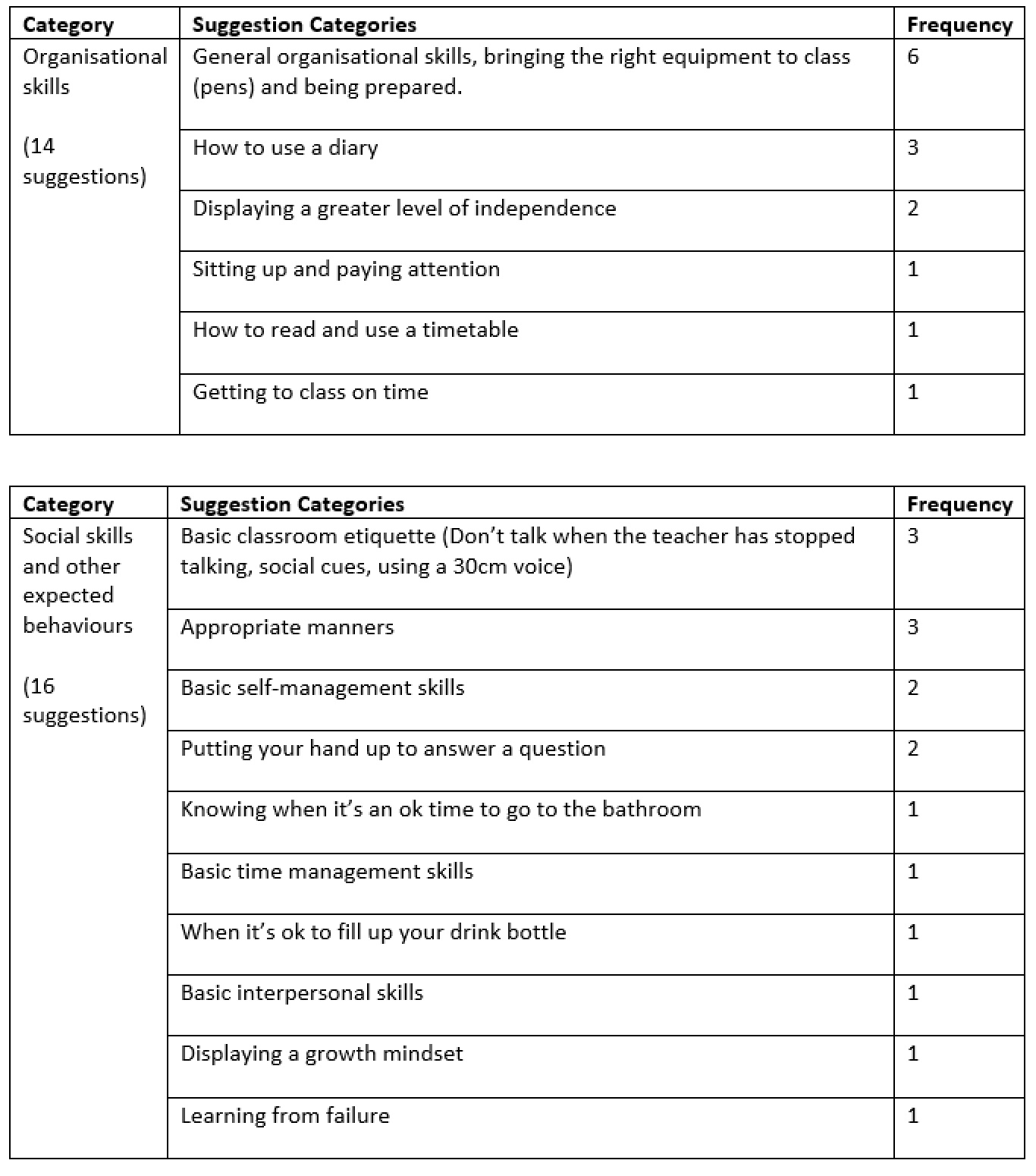


Implications for Primary School Teachers
This data serves as an important source of reflection for how we could do things differently, it’s not meant as a reactive source of criticism. Primary school teachers are teaching our students the vast majority of the concepts mentioned in the data above to help with the high school transition. A point I’d like secondary teachers to consider is all the extra curricula activities we are required to implement and how they take up time that could be better spent covering these concepts. I could write an entire blog post about this but let’s get back to the topic at hand.
Starting with Mathematics, the quick recall of times tables facts is an essential skill for primary school students to have. Receiving this feedback validates my own teaching pedagogy and the strong emphasis I place on students quickly recalling their times tables. It also highlights the importance of our daily mental maths games we have as part of our numeracy block at our school. What I found surprising was that three secondary teachers mentioned their dislike for students measuring the length of objects in centimetres. I can see why they are asking for this as a lot of computer aided design programs and related industries rely on measuring in millimetres. I would have gone my whole teaching career unaware of this point if I didn’t ask this question on TeachMeet.
Science teachers emphasised how crucial it is for their new students to remember the different variables used in scientific investigations and how important it is for them to independently write up procedures for science experiments. I remember going to a SciTech professional learning course back in 2013 and listening to a secondary teacher talk about how he wished his new students knew how to create line and bar graphs. I haven’t forgotten this point and I’ve made sure to include a series of lessons and assessments on these types of graphs.
The importance of basic reading and writing skills cannot be understated. This point was the most strongly emphasised out of all the comments on the thread. Most English teachers wished that their students had a stronger grasp on writing, and they wished their students had more knowledge about the different text types. I have been teaching my students how to take notes; however, considering the strong response to such a suggestion by our secondary teachers I will plan more lessons around explicitly strengthening this skill.
On the topic of organisation skills, a point was made about how upper primary school students should be using files instead of exercise books. Students will hardly ever need to glue anything into an exercise book at high school so why should they continue with this habit during their final year at primary school? I have also considered implementing a diary in my year five/six classroom but after seeing the comments on this thread I will definitely implement this suggestion next year.
With regards to expected behaviours and social skills, this is an ongoing battle that needs to be continually reinforced throughout primary and secondary school until the message sticks. We are dealing with ‘tweenagers’ after all. If you look throughout history, rude/obnoxious students have been a constant source of frustration for every generation of adults. Aside for consistently reinforcing and maintaining high expectations of our students I don’t think this is a thing that can be fixed quickly.
When it comes to thinking skills, I have been refining my questioning techniques to get students to fully explain their answers. This is where teaching students about meta-cognitive thinking strategies could be beneficial. For example teaching our students how to use the ‘six thinking hats’ and the ‘14 habits of mind’ could help further develop their critical thinking skills.
Finally, the area primary school teachers could improve the most in is with how we implement the ICT General Capabilities across all learning areas within our classroom. A common complaint that I hear from secondary teachers is that students don’t have the necessary computing skills for high school. Other comments that were well received included: how to use Connect, how to log onto the portal, how to access their emails, how to use Office 365 and basic computing skills. These skills include things like: turning on a computer, troubleshooting processes to follow if something does not work and how to organise their files and folders. One of the reasons why I think we need to improve in this area has to do with our assumption about our students being ‘digital natives’. I’ve always considered the word assume to be the most dangerous word in education and I think we have had, at times, assumed that our students just know this stuff. Having previously taught Digital Technologies for two years I can certainly tell you that students don’t automatically know about all the skills out lined in the ICT general capabilities. I also understand how the lack of computers and devices in some schools will affect the ability of the teachers at that school to implement the ICT general capabilities across the learning areas. I will write a blog post about this topic at a later date with suggestions for integrating these capabilities within the different learning areas.
I hope this blog post has encouraged some reflective thought amongst primary school teachers. I know it has certainly made me think about what I can do differently to help secondary school teachers with the transition of their new students into high school. We need to focus on the things we can control and what we can control is what we decide to teach in our learning areas. Thankyou for reading this blog post. If you have any feedback, please don’t hesitate to reach out to me on social media.
IF YOU THINK THIS WEBSITE IS AWESOME THEN PLEASE ...
Bookmark this page.
Follow us on Instagram | @griffin_edu
Like and follow us on Facebook | @griffineducationenterprises
Follow us on Twitter | @Griffin_Edu
Follow us on Pinterest | Griffin Education Enterprises
Join our mailing list down below.
Consider supporting us on Patreon.
And most importantly, share this website with other educators!

3 Ways Google Docs Can Help with Your End of Semester Reports
Looking for ways to speed up the reporting process? Then click here to found out ‘3 Ways Google Docs Can Help With Your End of Semester Reports’.
Changing how we do things can seem like a daunting task, especially when we’ve found a routine that works for us. I used to always write my end of semester reports in Microsoft Word on my desktop computer because that’s what I’ve always done and that’s how I completed all of my university assignments. This was back in 2002 when I first started my bachelor’s degree for those of you who might be slightly younger than I am. As I began to use by mobile devices more often, I realised that I was not always confined to the shackles of my desk at night. A new world of possibilities opened to me and I realised that there was a better way of doing things. So here are 3 ways Google Docs can help with your end of semester reports.
Write Your Reports Anywhere
The Google Docs word processor is a cloud-based application. This means that your documents, in this case your reports, are not automatically saved to your device’s hard drive but on Google’s server. If you have access to another computer, cellular signals on your SMART phone or a Wi-Fi signal then you have access to your end of semester reports. Google docs can be freely down loaded onto your SMART phone or tablet device. This means that you can write out your reports sitting down on the couch or when lying in bed. I do a lot of tutoring and sometimes my sessions are cancelled at the last minute. These cancellations have allowed me time to finish off a couple of comments in between sessions. You can also add to this any situation where you might be waiting e.g. when waiting for a haircut or when waiting for a doctor. These times are perfect for finishing off a couple of comments. If you implement this habit, then the task of writing out your reports will be over sooner.
Get Feedback from Admin Sooner Rather Than Later
A few teachers might be reluctant to implement this change but hear me out. I personally recommend that you create a shareable folder with admin so they can see a copy of your reports or at least a sample of your writing in Google Docs. If you don’t know how to create a shareable folder but are interested in learning how, then read my blog ‘3 Ways Google Drive Can Help Teachers’. The benefit of this strategy is that admin can provide you with feedback about the direction of your reporting style to see if you are on the right track. I recommend that you do this if you have a new line manager or if your school is changing the reporting style it expects from teachers. There is nothing worse than having to completely change your reporting style at the last minute.
Google Docs = Microsoft Word
The writing style of an end of semester report does not require all the bells and whistles of a paid program. All you really need to do is to type the thing out and maybe keep a table or two to track data. Having used Google docs for three years I have not come across an essential functionality required for writing reports on either program that has locked me into using one word processor over the other. So, in this regard Google Docs is comparable to Microsoft Word. You could also say the same for Pages; however, I hardly ever use Apple’s word processing application. Lastly you can also install a Chrome Extension that enormously helps with the editing phase of writing. It’s a text to speech program called ‘Read Aloud’ and it works perfectly with Google Docs. If you’re interested in this reporting hack then click here to read ‘Level Up Your Writing With Text to Speech Programs’.
So, there are 3 ways Google Docs can help you with your end of semester reports. If you liked this blog or anything else on our website then leave a comment on social media or click on the contact us webpage to send me an email. I love to receive any feedback about how this website has helped you or if you have any suggestions about how this website can be improved.
BEFORE YOU GO
Griffin Education Enterprises is registered as an Amazon Associate.
At Griffin Education Enterprises, we only include links to products that we can personally vouch for. We recently purchased a WiFi Extender that worked perfectly for one of our router’s ‘dead spot’. If you click on the links below and make a purchase, then we receive a small commission that is not included on top of the final price of the product/s you purchased. If you do end up purchasing something, then this commission helps us to cover the costs of running this website.
If you’re not in the market for these products yet, then we would greatly appreciate it if you purchased them through these links in the future. So please, bookmark this link.
Thanks for your consideration and thank you for supporting Griffin Education Enterprises.

IF YOU THINK THIS WEBSITE IS AWESOME THEN PLEASE ...
Bookmark this page.
Follow us on Instagram | @griffin_edu
Like and follow us on Facebook | @griffineducationenterprises
Follow us on Twitter | @Griffin_Edu
Follow us on Pinterest | Griffin Education Enterprises
Join our mailing list down below.
Consider supporting us on Patreon.
And most importantly, share this website with other educators!

3 Ways Google Drive Can Help Teachers
Don’t know how to share large files with other teachers without physically handing them a copy? Needs ideas on how to make sick days smoother? Ever lost your data? Then this is the blog for you!
Sometimes the simplest change is the one that has the most effect. In this week’s blog as part of my #weeklyblogchallenge I wanted to go over how Google Drive has helped me as a teacher. Three years ago I challenged myself and looked into all of Google’s applications to see what they were all about. One application that took my interest was called Google Drive. For those of you who have never heard of Google Drive, it’s like having a wireless hard drive across all your devices. So here are ‘3 Ways Google Drive Can Help Teachers.’
#1 Go Wireless & Back Up Your Data, Now!
At the start of this year I lost my USB stick. I was absolutely devastated by the loss of my assessment data, rubrics, letters and work-related files. You name it, I lost it. Words cannot adequately describe the extent of my loss. Fortunately, I did a backup in May 2018 to my Google Drive; however, I have been unable to recover the majority of my files after this date. To prevent a loss such as this from recurring I have now gone wireless and moved most of my work to Google Drive. I strongly suggest that you go and back up your data now.
#2 Being Able to Share Large Files
Before Google Drive, I used to email myself files occasionally if I didn’t have my USB stick available. While this method does work it rapidly fills up your email account’s data limit. Also, emails have an attachment limit of about 10-20 mb. If you have files with a large amount of data on them then you cannot use this method. To get around this problem I started uploading large files (movies, anything over 10 mb) to a new folder on my Google Drive.
Procedure for sharing content on Google Drive
When in Google Drive, right click and then click on new folder.
Give the file a name and click create
On the ‘Share with others’ screen click on advanced
Then in sharing settings click on ‘Change’
Then click on your preference of sharing. I typically use ‘On – Anyone with the link’ and allow them to organise, add and edit depending on the task.
Click save, upload your content and send the person a shareable URL.
An example of where this was useful was when I needed to share a video of a traditional Aboriginal dance I filmed for another teacher. She needed this for her AITSL portfolio pending graduation. I simply followed the procedure listed above and was able to share this file without physically handing her a copy on a USB stick.
#3 Quickly Share Information with Relief Teachers on Sick Days
Imagine this scenario. You wake up sick (or an emergency happens) and don’t have time to rush over to school to get any photocopying done. You must prioritise the daily work pad, so the relief teacher knows what to do; however, they won’t have the necessary files to print off. Well with Google Drive you can at least upload this to your relief teacher’s folder. That way they can print off any work that’s required for the day as if you were there doing it for them. I have also started to compile a generic list of worksheets and instructions for the day in my relief teacher’s folders just in case I don’t have time to create a daily work pad.
So there are ‘3 Ways Google Drive Can Help Teachers’. If you liked what you just read, then please don’t hesitate to contact me on social media. If any other Google applications interest you, then read our blog on ‘How to Use Google Forms to Automate Your Marking’.
Oh, and go back up your data right now just in case you forgot my suggestion!
BEFORE YOU GO
Griffin Education Enterprises is registered as an Amazon Associate.
At Griffin Education Enterprises, we only include links to products that we can personally vouch for. We recently purchased a WiFi Extender that worked perfectly for one of our router’s ‘dead spot’. If you click on the links below and make a purchase, then we receive a small commission that is not included on top of the final price of the product/s you purchased. If you do end up purchasing something, then this commission helps us to cover the costs of running this website.
If you’re not in the market for these products yet, then we would greatly appreciate it if you purchased them through these links in the future. So please, bookmark this link.
Thanks for your consideration and thank you for supporting Griffin Education Enterprises.

IF YOU THINK THIS WEBSITE IS AWESOME THEN PLEASE ...
Bookmark this page.
Follow us on Instagram | @griffin_edu
Like and follow us on Facebook | @griffineducationenterprises
Follow us on Twitter | @Griffin_Edu
Follow us on Pinterest | Griffin Education Enterprises
Join our mailing list down below.
Consider supporting us on Patreon.
And most importantly, share this website with other educators!
Concerned about what precautions you should take to protect your professional image? Then read this blog to find out how.